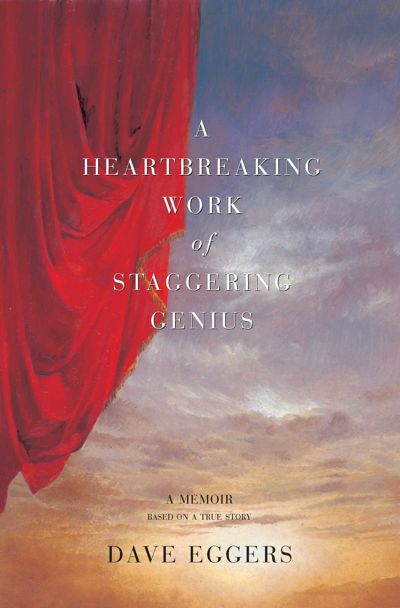
A Heartbreaking Work Of Staggering Genius

A Memoir Based on a True Story

Description

Pulitzer Prize Finalist

From the bestselling author of The Circle and The Eyes and the Impossibles comes the “profoundly moving, occasionally angry, and often hilarious” (The New York Times Book Review) memoir chronicling Dave Eggers’s life after losing both of his parents within a span of five weeks.

When twenty-one-year-old Dave Eggers loses both of his parents within weeks of each other, he suddenly becomes the primary caregiver to his eight-year-old brother, Toph. What follows is a wild, imaginative, and brutally honest account of growing up too soon.

Brimming with unconventional humor, poignant reflection, and unique narrative flair, A Heartbreaking Work of Staggering Genius is more than just a memoir. Eggers manages to turn his story of grief into a fearless exploration of what it means to survive, to hold a family together, and tell your story on your own terms.

About the author(s)

Dave Eggers is the bestselling author of seven books, including A Hologram for the King, a finalist for the National Book Award; Zeitoun, winner of the American Book Award and Dayton Literary Peace Prize; and What Is the What, which was a finalist for the National Book Critics Circle Award and won France’s Prix Medici. That book, about Valentino Achak Deng, a survivor of the civil war in Sudan, gave birth to the Valentino Achak Deng Foundation, which operates a secondary school in South Sudan run by Mr. Deng. Eggers is the founder and editor of McSweeney’s, an independent publishing house based in San Francisco that produces a quarterly journal, a monthly magazine, The Believer:, a quarterly DVD of short films and documentaries, Wholphin; and an oral history series, Voice of Witness. In 2002, with Nínive Calegari he cofounded 826 Valencia, a nonprofit writing and tutoring center for youth in the Mission District of San Francisco. Local communities have since opened sister 826 centers in Chicago, Los Angeles, New York, Ann Arbor, Seattle, Boston, and Washington, D.C. Eggers is also the founder of ScholarMatch, a program that matches donors with students needing funds for college tuition. A native of Chicago, Eggers now lives in Northern California with his wife and two children.

Reviews

Jim Lewis author of Why the Tree Loves the Ax This is a blurb. It conveys no information about the book whatsoever, no useful account of its contents, nor any serious comment as to its qualities. Authors like getting blurbs because they indicate that the author is an amiable and well-connected fellow; other authors like giving blurbs because it's free advertising for their own work. Editors and publicists like blurbs because blurbs help legitimize their own generally rather timid publishing decisions. You, the reader, are not exactly ill-served by this process -- it is, at worst, a harmless display of vanity and insecurity -- but if you're looking for a reason to buy and read this book, you're better off relying on the advice of other readers whose taste you share, or what minimal sense of the writing herein you can glean by standing here and skimming through the pages.

David Remnick Eggers is an original new voice, the real thing. When you read his extraordinary memoir you don't laugh, then cry, then laugh again; you somehow experience these emotions all at once -- and powerfully.

David Sedaris The force and energy of this book could power a train.

David Foster Wallace The thing took off for me in the basement and didn't stop. I am scared to fly and find it hard to read on planes, but coming back from Washington I was in the part about the cemetery and Bonaduce and the cremains looking like cat litter and it being her birthday, and I didn't even notice we'd landed till everybody started getting up. I shit you not. That is a big deal. A note is hit there, and sustained -- it is terribly, terribly moving, without being in any way gooey or contrived. Fine, fine writing. And while I admired many of the headier, more po-mo comic bits -- the long meditation on the idea of a story about John's suicide, for example, as well as the fake dialogues with Toph where he metacriticizes the book and completely vivisects all your hypocrisies. These bits are strong in kind of the obverse way, i.e., they are smart and self-conscious without being cold. I thought the places where you cut loose and did arias of grief, like at the church, were the book's best art. Also its bravest: I believe I know how horrible is the prospect of bathos or sentimentality to you (it is to me, anyway, as a writer, and I don't have a history that's as off-the-charts sad and rife with bathos-hazard as yours), and I report here that I was almost as moved by your willingness to risk it as I was impressed by the high-wire skill with which you avoided it. It's a merciless book.

More by Dave Eggers

More Biography & Autobiography

More Literary Figures

More Personal Memoirs