“I have always been uneasy about the philosophical and scientific underpinnings of ‘sustainable development.’ With A Poverty of Reason, we now have an excellent book which carefully examines these concerns and which can be used to seriously debate the concept.”
Description
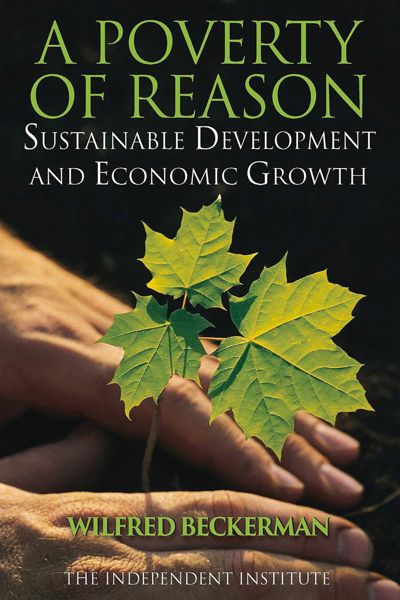
Environmental activists, politicians and celebrities have touted the wisdom of "sustainable development" as though its meaning and value were clear. But the concept has barely been defined, let alone subjected to scientific, economic, and philosophical scrutiny.
Oxford University economist Wilfred Beckerman puts "sustainable development" to the test, questioning several of its core claims: Will economic growth burn itself out by depleting the natural resources it requires? Will global warming wreak widespread havoc? Does human activity threaten to throw a delicate planet dangerously "out of balance"? Do future generations possess rights that morally override the claims of those alive today? At what price?
After examining the evidence, Beckerman finds "sustainable development" lacking on both scientific and moral grounds. Although millions of people lack clean air and water, and are plagued by deteriorating ecosystems, these problems are caused not by "unsustainable development" but by poverty, poorly defined property rights, and lack of freedom of opportunity. And, Beckerman concludes, because "sustainable development" recommends policies that would worsen these conditions (for present and future generations), it hardly occupies the moral high ground, as its supporters claim.
A Poverty of Reason provides a critical examination of this highly controversial topic and will prove essential in the ongoing debate about environmental and economic practices.
Reviews
“Beckerman, an Oxford economist, takes on three phrases frequently invoked in debates over environmental policy: ‘sustainable development,’ ‘the precautionary principle,’ and ‘intergenerational equity.’ He demonstrates that each is highly problematic—and that some interpretations of them could have detrimental effects on the world’s poor and on future generations. Beckerman finds clear thinking and clear expression deficient in most public debate (even among those who know better), and his discussion of climate change and biodiversity has resonance well beyond those two illustrations. . . . Serious debate about current actions (on inactions) with long-term effects must take into account Beckerman’s cogent arguments.”
“In A Poverty of Reason, Wilfred Beckerman brings wisdom and wit to his examination of major themes found in today’s environmental policy. With his economist’s scalpel, he cuts to the core of high sounding words and phrases such as ‘sustainable development’ and finds hopeless contradiction. Not much for slogans, Beckerman goes far beyond the usual in developing recommendations for environmental policy. In his view, governments that seek to provide ‘greener pastures’ must emphasize economic growth and enhanced protection of human rights and liberty.”
“Wilfred Beckerman, an Oxford University Emeritus Fellow in Economics, disputes global climate change concerns and the need for sustainable development. . . . The author poses the following questions: What exactly is ‘sustainable development’ and what does it require? The answer is by no means obvious. How does one select from among competing needs and trade-offs? . . . [I]n Beckerman’s view, the application of the precautionary principle, ‘one of the basic principles of sustainable development,’ is not economically justified.”