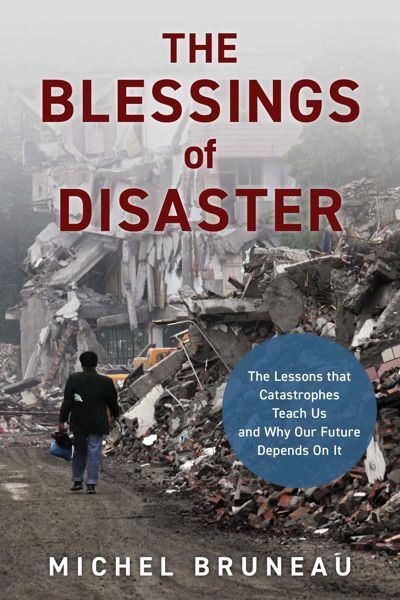
Blessings of Disaster

The Lessons That Catastrophes Teach Us and Why Our Future Depends on It
Description

Are we doomed? As individuals, certainly, eventually, inevitably. But as a species? As a civilization? Leading catastrophe engineer Michel Bruneau thinks perhaps not. The Blessings of Disaster draws on knowledge from multiple disciplines to illustrate how our civilization’s future successes and failures in dealing with societal threats—be they pandemics, climate change, overpopulation, monetary collapse, and nuclear holocaust—can be predicted by observing how we currently cope with and react to natural and technological disasters. Maybe most importantly, this entertaining and often counter-intuitive book shows how we can think in better ways about disasters, to strengthen and extend our existence as both individuals and as a species.

When it comes to rare extreme events, such as earthquakes, hurricanes, floods, tornados, volcanic eruptions, technological accidents, terrorist attacks, pandemics, and even existential threats, it is in our nature to set ourselves up for disasters because the gamble may be worth it. But only maybe.

The Blessing of Disaster is the very real story of the relationship between humans and disasters – and it’s not a simple one. Bringing together his decades-long career spanning the globe as an earthquake and disaster engineer, detailed catastrophe case studies from extreme events like Japan’s Kobe earthquake and category 5 hurricanes in the American South, along with thoughtful and practical solutions, Bruneau provides a thorough examination of the structural challenges that face today’s (and tomorrow’s) world.

How we cope with today’s threats is indicative of what the future holds. Contrary to popular forecasts, it is not all gloom and doom – but some of it definitely is.

Reviews

Michel Bruneau is a master of disaster! Drawing on his decades of expertise in delving into the mysteries of mayhem, The Blessings of Disaster makes the unthinkable thinkable. With humor and great wisdom, Bruneau takes us on what turns out to be a hopeful journey to confront a reality that we too often deny; disasters are neither rare nor unknowable. Along the way he empowers us to do what we must do; to think anew and act anew in face of naturally-occurring and human-made hazards. Bruneau reminds us that while we cannot prevent earthquakes, volcanoes, hurricanes, and much more from happening, we are not powerless in mitigating their consequences. He shows us that by confronting head-on what has always frighten so many of us, we can become less afraid about the prospect and necessity of building a more resilient world.

Stephen Flynn, Founding Director, Global Resilience Institute at Northeastern University, and author of the national bestseller America the Vulnerable

Michel Bruneau has given readers an entertaining and sometimes laugh-out-loud funny tour of a deadly serious topic: hazards and disasters and the ways in which engineering and scientific discoveries seek to reduce their impacts. Bruneau takes us through history and around the world to well-known and less-familiar disaster hot spots and offers fascinating details about past devastation and looming threats. A must-read for anyone—general audiences, students, and specialists alike—wishing to understand the challenges associated with disaster mitigation and management.

Kathleen Tierney, Professor Emerita of Sociology and former Director of the Natural Hazards Center, part of the Environment and Society Program in the Institute of Behavioral Science, University of Colorado Boulder

The central theme of Michel Bruneau’s book, The Blessings of Disaster, is that “it takes a disaster to change life for the better”. He approaches his theme with wry, witty (sometimes sarcastic) discussions of earthquake, wind, volcanic, tsunamis, climate, population, and nuclear disasters. His analogies to explain complex concepts and interesting asides to basic facts add to the readability for both technical and non-technical readers. The book weaves the effects of politics and forms of government into how humans react to and prepare for disasters with speculation on several scenarios for the future. The Blessings of Disaster is an enjoyable, yet educational read and a good rant on how we approach the safety of our infrastructure.

Andrew Herrmann, President Emeritus of the American Society of Civil Engineers, President Emeritus of the Structural Engineers Institute, Partner Emeritus, Hardesty & Hanover Consulting Engineers, and Past member of ASCE’s Advisory Council which produced the 2001, 2003, and 2005 “Report

The Blessing of Disaster” by Michel Bruneau is a must read, touching the lives of everyone! It turns the broad subject of natural and anthropogenic hazards into exciting and delightful lessons for us all, for the benefit of all. The book is thought-provoking and factual, blending eloquently the physical phenomena behind hazards with human traits and psychology in response to hazards, and lack thereof that may turn them into disasters; a lesson for us all to learn. The author uses his technical expertise on earthquake engineering, blending it impeccably with other types of natural and human-induced hazards while bringing personal anecdotes, sprinkled with his wit, guaranteed to put a smile on your face. The author skillfully weaves through a range of disasters, ranging from earthquakes, volcanos, tsunamis, extreme weather events all the way through to those caused by technological hazards, ill-intended acts of terror, financial disasters, pandemics, climate change, and potential nuclear holocaust. Exposing remarkable similarities in the way we react to them, sure to spike your curiosity. The book will make you think differently about the way you react to disasters, or even better, act proactively to lessen their impacts. It will be read for a long time, benefitting its readers, and potentially enlightening policy makers. This book is a gem to keep in your library. An exciting and engaging book for all!

Murat Saatcioglu, Distinguished University Professor and former Director of the Hazard Mitigation and Disaster Management Research Centre, University of Ottawa, former President of the Canadian Association for Earthquake Engineering, and Fellow of the Canadian Academy of Engineers

More by Michel Bruneau

More Natural Disasters

More Nature

More All Other Nonfiction

More Civil

More Technology & Engineering