“Few issues remain more confused than economic upheavals like the Great Depression and Great Recession. The superb book Boom and Bust Banking now shows the Federal Reserve’s role and provides incisive cures to end the current debacle. The real news is the emerging consensus among economists as diverse as John Taylor and Lawrence White on the monetary origins of the crisis. Everyone should read this book.”
Description
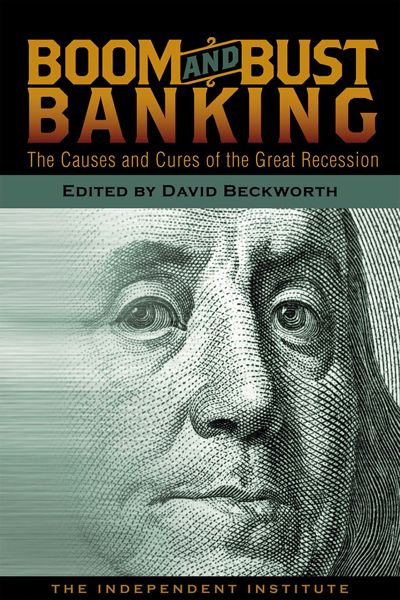
Exploring the forceful renewal of the boom-and-bust cycle after several decades of economic stability, this book is a research-based review of the factors that caused the 2008 recession. It offers cutting-edge diagnoses of the recession and prescriptions on how to boost the economy from leading economists.
Congress created the Federal Reserve System in 1913 to tame the business cycle once and for all. Optimists believed central banking would moderate booms, soften busts, and place the economy on a steady trajectory of economic growth. A century later, in the wake of the worst recession in fifty years, Editor David Beckworth and his line-up of noted economists chronicle the critical role the Federal Reserve played in creating a vast speculative bubble in housing during the 2000s and plunging the world economy into a Great Recession.
As commentators weigh the culpability of Wall Street’s banks against Washington’s regulators, the authors return our attention to the unique position of the Federal Reserve in recent economic history. Expansionary monetary policy formed the basis of the soaring housing prices, excessive leverage, and mispricing of risk that characterized the Great Boom and the conditions for recession.
Yet as Boom and Bust Banking also explains, the Great Recession was not an inevitable result of the Great Boom. Contrary to the conventional wisdom, the Federal Reserve in fact tightened rather than loosened the money supply in the early days of the recession. Addressing a lack of critical studies of recent Federal Reserve policy, Boom and Bust Banking reveals the Federal Reserve’s hand in the economy’s deterioration from slowdown to global recession.
At the close of the most destructive economic episode in a half-century, Boom and Bust Banking reconsiders the justifications for central banking and reflects on possibilities for reform. With the future ripe for new thinking, this volume is essential for policy makers and concerned citizens who wish to learn from recent history.
Reviews
“The preeminent economic challenge of our time finally gets the attention it deserves in the very important book from leading monetary thinkers, Boom and Bust Banking. Distinguished economists such as George Selgin and Lawrence White address how the boom-and-bust cycle engendered by central banks creates financial instability and dare to propose alternative monetary arrangements. Inherent throughout this volume is the fundamental question: Is the Federal Reserve capable of appropriately calibrating the money supply to the needs of the real economy? To give an informed answer – read this book.”
"Boom and Bust Banking is another pathbreaking work from the Independent Institute."
“David Beckworth is a young intellectual leader in what has been dubbed ‘market monetarism,’ which focuses on monetary policy as a key factor in economic fluctuations, including in the great recession of 2008-09. Beckworth has succeeded in assembling a superb group of contributors who have written stimulating essays on this topic. Boom and Bust Banking is an important contribution to furthering our understanding of recent events in the U.S. and around the world.”