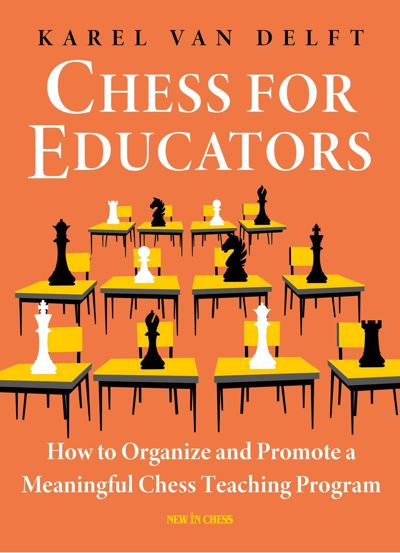
Chess for Educators

How to Organize and Promote a Meaningful Chess Teaching Program
Description

Chess has the rare quality that children love it despite the fact that it is good for them. Playing chess is just like life: you have to make plans, take decisions, be creative, deal with challenges, handle disappointments, interact with others and evaluate your actions.

Psychologist and chess teacher Karel van Delft has spent a large part of his life studying the benefits of chess in education. In this guide he provides access to the underlying scientific research and presents the didactical methods of how to effectively apply these findings in practice.

Van Delft has created a dependable toolkit for teachers and scholastic chess organizers. What can teachers do to improve their instruction? How (un)important is talent? How do you support a special needs group? How do you deal with parents? And with school authorities? What are the best selling points of a chess program? Boys and girls, does it make a difference? How do ‘chess in schools' programs fare in different countries?

This is not a book on chess rules, with lots of moves and diagrams, but it points the way to where good technical chess improvement content can be found. Van Delft offers a wealth of practical advice on how to launch and present a chess program and how to apply the most effective didactics in order for kids to build critical life skills through learning chess.
Reviews

"More than 260 pages of pure motivation and inspiration. While other school chess books focus on concrete lessons, Karel van Delft provides insight into everything else that should be in the chess teacher's school bag (chess and autism, chess and girls, chess as a social and therapeutic tool, the role of the parents, etc). The author strikes a wonderful balance between practical tips and scientific foundation. You can use some pages as a checklist, on the other hand the references to scientific works can make any school headmaster realize that chess really belongs in the classroom. And isn't that exactly what we need to spread chess in schools?"

Phillippe Vukojevic, First Rank Newsletter

"Deep insights into the didactics!"

Karsten Muller, Grandmaster

"This book does not need to be read systematically. It is a work of ideas and advice, which will retain a long shelf life. Chess tutors and teachers will be able to dip into the book in search of inspiration and they will certainly find it waiting for them. It doesn't matter how experienced a teacher or tutor may be: there will always still be plenty of new ideas to be found in 'Chess for Educators'."

Sean Marsh

"Going through the book I encountered things that I had hardly heard of and that sometimes opened up an entire world to me, although I have been teaching chess for many years. Chapter 20 is an important one because it concentrates on research into the benefits of teaching chess. I think that many chess players will be able to identify with the section 'Losing Touch with School'. All in all a monumental work that deals with lots of aspects of teaching, coaching and organizing, but also with communication and promotion."

Herman Grooten, International Master

More Chess

More Games & Activities