Crossroads for Liberty

Recovering the Anti-Federalist Values of America's First Constitution

Description

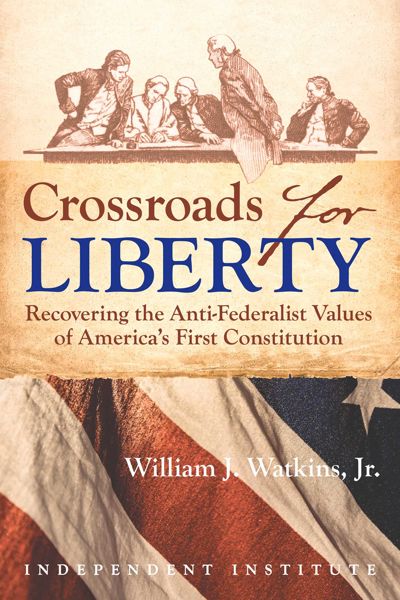
What did the American Founders actually intend for the country, and does it even matter today? If America began as an idea, then what kind of idea?

In a time of increasing turmoil over American history, politics, and society, Crossroads for Liberty: Recovering the Anti-Federalist Values of America’s First Constitution takes a surprising and thought-provoking look at the American Revolution, the Articles of Confederation, and the Constitution, and asks what we can learn from them.

Author William Watkins casts a critical eye on conventional wisdom about the Articles of Confederation, as he outlines the differences between that original U.S. governing document and the Constitution, which replaced it. He finds that the Articles protected individual liberty and community-centered government in ways that the looser language of the U.S. Constitution did not. Watkins draws from contemporary examples of bureaucratic overreach and expansion to support his argument—examples that were startlingly predicted by proponents of small government at the time of the Constitution’s adoption. Along the way, he points back to the Articles and the values of the American Revolution as a framework for reimagining American politics to foster liberty and truly representative governance.

Crossroads for Liberty arrives at an important time in American political life, and its reexamination of the American Founding presents a significant contribution to the story about America. Readers will come away with a greater understanding of current political and constitutional issues, as well as a new perspective on American history.
About the author(s)

William J. Watkins, Jr. is a Research Fellow at the Independent Institute and author of the book Crossroads for Liberty: Recovering the Anti-Federalist Values of America's First Constitution. He received his B.A. in history and German summa cum laude from Clemson University and his J.D. cum laude from the University of South Carolina School of Law, and his LL.M. with merit from the University of London. Mr. Watkins is a former law clerk to Judge William B. Traxler, Jr., of the U.S. Court of Appeals for the Fourth Circuit, and he is President of the Greenville, SC, Lawyers Chapter of the Federalist Society. He has served as a prosecutor and defense lawyer, and has practiced in various state and federal courts. He lives in Logan, Utah.

Reviews

“For more than two decades William Watkins has been exploring alternative views of our republican traditions, and, in the process, has become one of our most provocative and insightful constitutional historians. With Crossroads for Liberty and in an era when we are increasingly coming to realize that we live in a time of government gone amok, Watkins has produced a splendidly inspiring look at the Anti-Federalists, who were able presciently to warn us of the perils to come. Watkins not only gives us a superb exposition of their thought, but he reminds us of some of the wisdom of our First Constitution (the Articles of Confederation, which are helpfully reproduced as an appendix), and offers us some remedies for our ailing polity.”

Stephen B. Presser, Raoul Berger Professor of Legal History Emeritus, Pritzker School of Law, Northwestern University; author, The American Constitutional Order; Recapturing the Constitution; Individual Rights and the Constitution; The Origin

“At a time in our history when most people take it as an article of faith that the federal government must provide a solution to every major problem, from education to terrorism to economic downturn, the indispensable book Crossroads for Liberty advances the notion that our massive federal government is the problem, and that the solution lies in ideas that have lain dormant for over two centuries. William Watkins gives much needed consideration to the unwisely disparaged ideas of the Anti-Federalists and, particularly, the Articles of Confederation. According to Watkins, the Constitutional Convention of 1787 would have been far wiser to stick with its assigned mission of proposing amendments to the Articles, rather than creating a wholly different and far more centralized form of government that has grown into the behemoth we have today. Recognizing that we cannot turn back the clock and return to the Articles of Confederation, Watkins nevertheless believes that the Articles and their Anti-Federalist proponents have invaluable lessons to teach us, if only we open our minds to the possibility. We would be wise to listen.”

Alex A. Kozinski, Judge, U.S. Court of Appeals for the Ninth Circuit

“In his important book, Crossroads for Liberty, William Watkins astutely urges us to study the Framers, but not merely the Federalists. Close attention should be paid to the Anti-Federalists and the contemporary weakening of separation of powers and checks and balances. Instead of a system of self-government, political power has shifted in ever greater degree to the President and the Supreme Court. The results should concern us all.”

Louis Fisher, Scholar in Residence, The Constitution Project; author of Presidential War Power, The Law of the Executive Branch, Constitutional Conflicts Between Congress and the President, and other books

“In the compelling book Crossroads for Liberty William J. Watkins, Jr. recounts the rarely examined history of lost liberty in America’s infancy. In a truly eye-opening historical examination, Crossroads explains how the principal goal of the American Revolution in 1776—the removal of centralized power in favor of diverse and independent local and state governance, in which individual Americans could select the level and severity of the governance they wished for themselves—was abandoned in just eleven years. If you yearn, as I do, for minimal government and maximum individual liberty, you need to understand how the monster federal government came about. Crossroads is that well-told but sad story.”

Andrew P. Napolitano, Senior Judicial Analyst, Fox News Channel; Distinguished Visiting Professor of Law, Brooklyn Law School; author, The Constitution in Exile, Constitutional Chaos, Suicidal Pact, Dred Scott’s Revenge, and other books

More by William J. Watkins Jr.

More Revolutionary Period

More United States

More History

More Legal History

More All Other Nonfiction

More National

More American Government

More Political Science