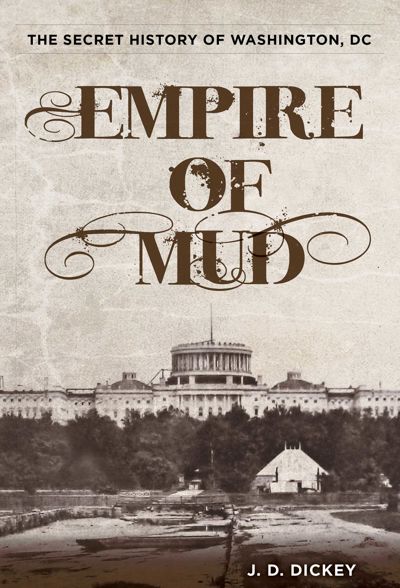
"Washington, DC, harbors a pervasive nest of secrets, audacious and trivial, but rarely has one so captivating emerged from its nineteenth-century swamps and mudflats. In a meticulously researched and swift-moving account, J. D. Dickey delivers a rollicking narrative of the capital in its squalid adolescence. Against a backcloth of George Washington’s and Pierre L’Enfant’s lofty ideals and the infuriating indifference of Congress, Dickey’s rascals and thieves connive to deprive the nation of its destiny. Whether you move and shake there or just visit with the kids on holidays, your notion of the city’s beginnings will be changed unalterably by this sturdy work of history."
—Chip Bishop, New York Times bestselling author of The Lion and the Journalist and Quentin and Flora
“A detailed peek inside DC’s not-so-glorious life before the Civil War. What has become prime real estate now was a disease-ridden swamp filled with shady characters. DC’s drainage problems are mostly solved, but the swamp of Washington politics lives on.”
—John Norquist, president of the Congress for the New Urbanism, author of The Wealth of Cities, and former mayor of Milwaukee, Wisconsin
“The rawness of mid-nineteenth-century urbanism, architecture, politics, and manners so commonly associated with the American Wild West had its perfect contemporary mirror image in the everyday reality of the capital city. Mr. Dickey’s versatile depiction of the heart of this commonly ignored American Wild East is not mere history but shapes American ethics and aesthetics to this day.”
—Léon Krier, winner of the inaugural Driehaus Architecture Prize and author of The Architecture of Community
"A funny, breezy, and deeply intelligent survey of the singularly strange project of building a national capital city from the ground up. Dickey is a marvelous historian and a hell of a stylist."
—James Howard Kunstler, author of The Geography of Nowhere and The Long Emergency
"J. D. Dickey's examination of the story behind the creation of the District of Columbia is enlightening, informative, and altogether a joy to read. He does a great job of raking through the muck of making the nation's capital and showing the reality of how Washington, DC, came to be. The research was thorough, the writing was engaging, and the storytelling top-notch. This is a great book for anyone interested in finding out the true story of our great capital’s origins not just as a piece of historical research but as a great tale told by a masterful storyteller.”
—Jesse J. Holland, author of Black Men Built the Capitol
"A spry and passionate historian, Dickey gets down and dirty. His hidden history of Washington is an artful mother lode of mud-flecked nuance and unexpected discovery, reminding us that this city of aspiration and monuments, white and clean, is built literally—and often figuratively—on a swamp."
—Ron Franscell, author of The Crime Buff’s Guide to Outlaw Washington, D.C.
Description
Washington, DC, gleams with stately columns and neoclassical temples, a pulsing hub of political power and prowess. But for decades it was one of the worst excuses for a capital city the world had ever seen. Before America became a world power in the twentieth century, Washington City was an eyesore at best and a disgrace at worst. Unfilled swamps, filthy canals, and rutted horse trails littered its landscape. Political bosses hired hooligans and thugs to conduct the nation's affairs. Legendary madams entertained clients from all stations of society and politicians of every party. The police served and protected with the aid of bribes and protection money. Beneath pestilential air, the city’s muddy roads led to a stumpy, half-finished obelisk to Washington here, a domeless Capitol Building there. Lining the streets stood boarding houses, tanneries, and slums. Deadly horse races gouged dusty streets, and opposing factions of volunteer firefighters battled one another like violent gangs rather than life-saving heroes. The city’s turbulent history set a precedent for the dishonesty, corruption, and mismanagement that have led generations to look suspiciously on the various sin--both real and imagined--of Washington politicians. Empire of Mud unearths and untangles the roots of our capital’s story and explores how the city was tainted from the outset, nearly stifled from becoming the proud citadel of the republic that George Washington and Pierre L'Enfant envisioned more than two centuries ago.
Reviews
Dickey brings the place to life, relating how it looked, felt, and fuctioned. . . .An entertaining story for local history enthusiasts or general readers eager to peek into the curiosities and scandals in the less-than-reputable past of the now glittering capital.
Certain adjectives spring to mind when reading this eye-opening, in-depth look at the history of America’s capital city in the 19th century: sordid, squalid, tawdry, filthy, and corrupt. Dickey pulls no punches as he examines the dark side of the District’s misspent youth, from its origins as a compromise carved from several states to its evolution into 'a fiefdom ruled by national politicians'—one whose 'citizens were denied the right to vote for those politicians.' Dickey covers every vice: murder, mayhem, political infighting, prostitution, incompetence, greed, dueling, slavery, and of course, war. Given the bleak portrait he paints of a city perpetually on the edge of chaos, where gangs clash and crime flourishes, where disease runs rampant, where civic projects and grandiose plans languish for decades, it’s amazing that the city survived long enough to endure its slow transformation into a real city—albeit one lacking certain rights and representation. Even as Dickey expresses a wistful nostalgia for long-vanished neighborhoods, he bemoans the District’s unique political nature. Only someone who loves the city can be so honest about its flaws, and this love shows in Dickey’s flowing style and knowledgeable approach.
So many large American cities evolved haphazardly over the course of centuries. Their origins, often shrouded in myths or legends, may be traced back to Native American meeting sites, primitive trading centers, or rudimentary agricultural settlement. In tracking the development of Washington, D.C., in the nineteenth and twentieth centuries, Dickey repeatedly stresses how the capital was different. This is an engrossing, revealing, but relentlessly depressing account of urban founding and development. According to Dickey, members of the Confederation Congress, frightened by threats from disgruntled military units around Philadelphia, saw the necessity to establish a more distant and secure capital. The Residence Act of 1790, a result of political horse trading between Thomas Jefferson and Alexander Hamilton, determined a more precise location. Dickey effectively illustrates the political and social instability that surrounded the construction of the city. As the city slowly expanded, it was fertile ground for greedy speculators, hordes of corrupt businessmen, and prostitutes. . . .[T]his is a useful. . . .account of the development of our capital.