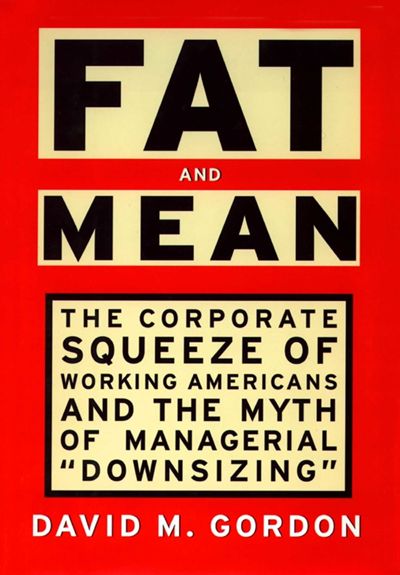
Since the early 1980s, economic experts have recommended "downsizing" as the best way for U.S. corporations to remain competitive. Reducing unnecessary staff would lower costs, increase profits, and transform these companies into lean, mean production machines. As many American businesses pursued this strategy—often in the wake of mergers and acquisitions that left them with an unwieldy layer of middle management—and raised their bottom line, it seemed the experts were right. Yet as David M. Gordon shows in this iconoclastic book, most of them have really only gone halfway. They are "mean," but far from lean.
Tracing the overall employment patterns of the past decade, Gordon shows that most American companies actually employ more managers and supervisors than ever before. These ever-increasing functionaries control company payrolls and pay themselves generous salaries—at the expense of average workers. For despite a steadily growing economy the real wages of the American worker have been falling for the past 20 years. To explain this decline and the much-debated "wage gap" that resulted, pundits and professors invoke various causes ranging from the flow of production jobs overseas to the average worker's lack of the technological skills needed in today's "knowledge economy." But Gordon exposes the single greatest factor in this decline, a corporate strategy that penalizes line workers and hinders businesses from competing effectively in world markets: the simultaneous overstaffing of management hierarchies and the inadequate compensation of workers.
Instead of sharing profits with their employees, thus encouraging them to work harder, management has more often opted to prod workers by instilling fear of layoffs. Gordon unerringly plots the shortsighted and disastrous course of U.S. corporations, and documents the tremendous social and personal costs to their employees. Yet in addition to telling the harsh truth about downsizing, he suggests policies to ensure fairer business practices. Wages can increase—
indeed, they must—as the economy begins to perform more efficiency.
U.S. corporations have become fat and mean. They need to become lean and decent—not just for the sake of their workers, but for the sake of their competitive advantage. This provocative and original book shows how they can.