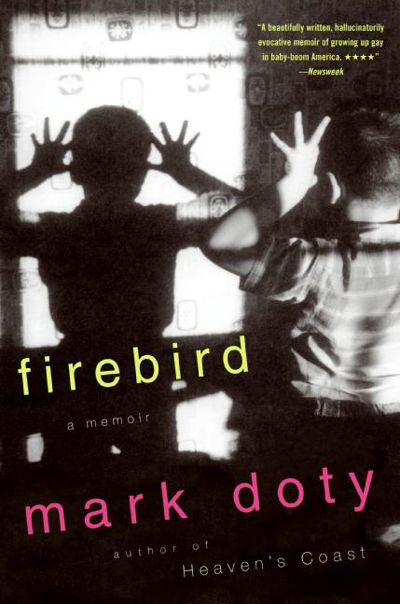
"With Firebird . . . Doty has written his most satisfying book . . . . [He] has elevated the story of his troubled family to the stature of myth, and in the process he has written an American classic." — Salon
"The poet's beautifully written, halucinatorily evocative memoir of growing up gay in baby-boom America." — Newsweek
"Doty writes with the characteristic Zen-calm you find also in his gorgeous poetry." — Los Angeles Times Book Review
"It is not so much Doty's experiences that elevate Firebird. It is the extraordinary lilt of his words, each chosen with great care, which make even ordinary moments. . . become fresh and indelible." — Fort Lauderdale Sun Sentinel
"A lyrical, heartfelt and ultimately haunting account. . . . It is a pleasure to read a memoir that eschews the outsized dramas of recent confessional volumes. . . .Firebird convincingly evokes the isolation and cruelty of childhood, the potent blend of torment and pride experienced by those who sense, from an early age, that they are different." — Washington Post Book World
"By the end of Mark Doty's exquisite memoir. Firebird, you'll have trouble believing you haven't read a brilliantly plotted novel by a master of fiction. But no made-up story could ever be as gripping as the one Doty tells, And few novelists could tell it this well." — San Francisco Chronicle
"By turns lyrically comic and deeply sad." — Out Magazine
"[Doty's] luminous portrait of the artist as a young man also illuminates the currents of his times, and contains a haunting family history. This is memoir at its best." — Booklist, starred review
"Incandescent. . . .a lasting work of art." — Time Out
"Supple, powerful reading. . . .[Doty] immerses his readers—at first in a leisurely manner, then with gathering intensity—in a gay coming of age complicated by complete family meltdown." — New York Times Book Review
"Vivid, exquisite. . . . Some memoirists attempt to reinhabit their childhood minds, with wildly varying results. . . .Doty does not. He is always the narrator walking through his own life, the man gazing upon the child. This method allows Doty to observes himself, sometimes with devastating scrutiny. It imbues this book with greater honesty and makes his observations—such as remembering himself as a "heavy little sissy in glasses"—all the more poignant." — Boston Globe