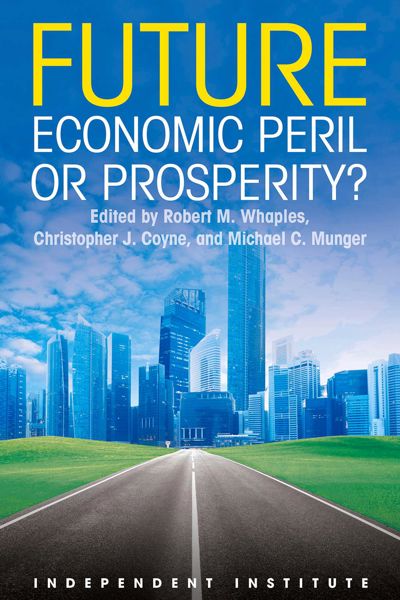
“From P.J. O’Rourke to Deirdre McCloskey, lemonade stands to bitcoin blockchains, uber economics to omniphagic software, the power grid to the connected home, Future is a diverse and dynamic cornucopia of historians, futurists, humorists, prophets, and economists discoursing disruptively on the prospects for our 21st Century economy.”
Description
What will the economy look like in fifty years? How will our lives as consumers and workers be transformed by the coming innovations in technology, the marketplace, and the workplace? How will changes in demographics and dependency affect our political system? Will economic freedom rise or fall? What, if anything, would greater prosperity do for one’s total well-being?
Future: Economic Peril or Prosperity? poses these and related questions to a diverse group of economists whose predictions will inspire thoughtful consideration and debate. As co-editor Robert M. Whaples writes in the introductory chapter, “The predicted changes range from innocent innovations that will make life a bit more comfortable...to potentially chilling technologies that might strip our human dignity.”
Just as important as the book’s predictions are its insights into how we should think about an uncertain future. As humorist and social critic P. J. O’Rourke shows in his erudite chapter on self-fulfilling prophecies, wildly wrong predictions are not limited to the likes of a Nostradamous or a Karl Marx: even a Nobel laureate economist running a billion-dollar hedge fund can lose the farm (and other people’s money) through an overly confident misreading of the economic tea leaves. And yet, perhaps only by delving more deeply into long-term forecasting, and reflecting on past mistakes, can we minimize the hubris that so often clouds the judgments of prognosticators in academia, business, and—perhaps especially—government.
Informative, contentious, and at times inspirational, Future: Economic Peril or Prosperity? is an invaluable aid for anyone who understands the need to prepare for the future, even if that future cannot be fully anticipated.
Reviews
“Future is exactly what I would expect from the Independent Institute. You will not likely have any sure answers when you finish reading this marvelous book, but I all but guarantee you that you will be asking far better informed questions than at the start. And given the confusing landscape called the future, that’s the whole point, isn’t it?”
“No one knows what the future will bring, but we do know what policies avert economic calamity and foster widespread prosperity. Future provides a roadmap for adopting the essential measures of liberty, entrepreneurship, and innovation. I highly recommend everyone read this pioneering book.”
“Future is an immensely readable and important book by an All-Star cast of thinkers about what the future may hold for all of us and what we should do now to avert calamity. Agree or disagree with their conclusions, they will make you think deeply about the important topics of freedom, prosperity, and economics.”