“What Kitamura summons brilliantly is the sensation of a repressed and repressive society laid bare - erotically, psychologically and politically. She writes with equal authority about the weight of a man’s gaze on a disrobing woman and the sensation of being exposed by history’s glare … Gone to the Forest confirms Kitamura’s prodigious talent.”
Description
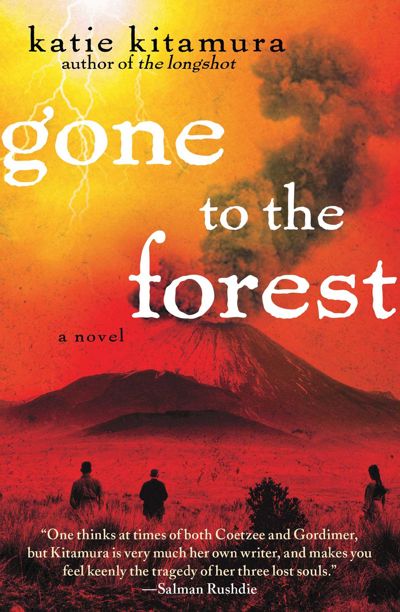
FROM THE CRITICALLY ACCLAIMED AUTHOR OF THE LONGSHOT comes this gripping saga about the destruction of a family, a home, and a way of life. Set on a struggling farm in a colonial country teetering on the brink of civil war, Gone to the Forest is a tale of family drama and political turmoil in which fiery storytelling melds with daring, original prose. Since his mother’s death, Tom and his father have fashioned a strained domestic peace, where everything is frozen under the old man’s vicious control. But when a young woman named Carine arrives at the farm, the tension between the two men escalates to the breaking point. Hailed by the Boston Globe as “a major talent,” Kitamura shines in this powerful new novel.
Reviews
“A startling, discomfiting work, written in razor-sharp prose. J.M. Coetzee’s work comes to mind, as does Michael Haneke’s, but there’s a sweet coldness here that is all Kitamura’s. This is her second novel, a brilliant book early in what will surely be a major career.”
"Darkly seductive"
“Hypnotic prose [with] flashes of unexpected beauty… so spare as to almost be incantatory… It marvelously suggests the chaotic, contradictory and highly changeable way the mind works…. Gone to the Forest, in just 200 pages, floats, unfolds and astonishes.”
— Marie Myung-Ok Lee, San Francisco Chronicle on Gone to the Forest
“Kitamura offers echoes of J. M. Coetzee’s Disgrace,coolly chronicling the family’s undoing as it tracks against the politicalturmoil ripping through the nation.”
—New York Times on Gone to the Forest
“A ruthless, controlled style distinguishes this novel about a man and his oppressive father in an unnamed colonial country that’s about to blow... [Kitamura’s] style reminds one of Marguerite Duras and Herta Müller—writers who have had to reckon with power in the colonial Indochina and the repressive Romania, respectively. Power is the subject, and the execution is precise.”