“Green on Blue is a novel that conveys, with harrowing power, the fallout that decades of war (going back through the Soviet occupation of the 1980s) has had on that country’s people, and at the same time, it’s a kind of Greek tragedy about the cycles of revenge and violence that can consume families and tribes, generation after generation…This novel as a whole attests to Mr. Ackerman’s breadth of understanding — an understanding not just of the seasonal rhythms of war in Afghanistan and the harsh, unforgiving beauty of that land, not just of the hardships of being a soldier there, but a bone-deep understanding of the toll that a seemingly endless war has taken on ordinary Afghans who have known no other reality for decades.”
Description
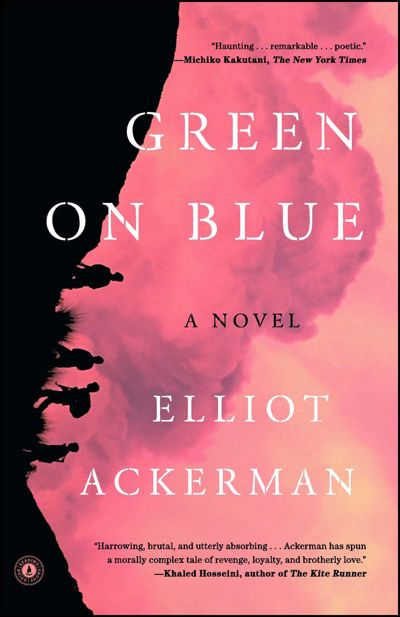
From the author of Waiting for Eden and the National Book Award Finalist Dark at the Crossing, a “compassionate, provocative, and alive” (Vogue.com) debut war story about a young Afghan orphan, “Green on Blue is harrowing, brutal, and utterly absorbing. With spare prose, Ackerman has spun a morally complex tale of revenge, loyalty, and brotherly love” (Khaled Hosseini, author of The Kite Runner).
Aziz and his older brother Ali are coming of age in a village amid the pine forests and endless mountains of eastern Afghanistan. They are poor, but inside their mud-walled home, the family has stability, love, and routine. One day a convoy of armed men arrives in their village and their world crumbles. The boys survive and make their way to a small city, where they gradually begin to piece together their lives. But when US forces invade the country, militants strike back. A bomb explodes in the market, and Ali is brutally injured.
To save his brother, Aziz must join the Special Lashkar, a US-funded militia. As he rises through the ranks, Aziz becomes mired in the dark underpinnings of his country’s war, witnessing clashes between rival Afghan groups—what US soldiers call “green on green” attacks—and those on US forces by Afghan soldiers, violence known as “green on blue.” Trapped in a conflict both savage and contrived, Aziz struggles to understand his place. Will he embrace the brutality of war or leave it behind, and risk placing his brother—and a young woman he has come to love—in jeopardy?
Green on Blue has broken new ground in the literature of our most recent wars, accomplishing an astonishing feat of empathy and imagination. Writing from the Afghan perspective, “Elliot Ackerman has done something brave as a writer and even braver as a soldier: He has touched, for real, the culture and soul of his enemy” (The New York Times Book Review).
Reviews
“The chief pleasures of Ackerman’s novel derive from its striking descriptions of men at war…Like all novels written in skilled, unadorned prose about men and women of action, this novel will probably be compared to Hemingway’s work. In this case, however, the comparison seems unusually apt…Elliot Ackerman has done something brave as a writer and even braver as a soldier: He has touched, for real, the culture and soul of his enemy.”

"Green on Blue is harrowing, brutal, and utterly absorbing. With spare prose, Ackerman has spun a morally complex tale of revenge, loyalty, and brotherly love. The saga of young Aziz is a chilling and often disturbing glimpse into one of the world’s most troubled regions."
"Elliot Ackerman departs from expectation in his debut novel, Green on Blue [...] allowing us to be repeatedly surprised as events unfold. The story reads quickly, and comparisons can be drawn with For Whom the Bell Tolls, Adventures of Huckleberry Finn and even Slumdog Millionaire…While most American writing about the desert wars explores the U.S. experience, Ackerman may be the first to devote his work to seeing beyond himself... The result is a work of imagination based on empathetic respect... He is, in this way, a storyteller like any in the Afghan mountains, his authority as a Marine veteran given away in favor of empathy for the people beside and against whom he fought. He invites us to sit by the fire with Aziz and hear what his people aren't able to say in our books about them."