“In Highway Heist, James Bennett provides vital, new, intellectual infrastructure for a timely and authoritative critique of pork barrels, potholes, and political privilege.”
Description
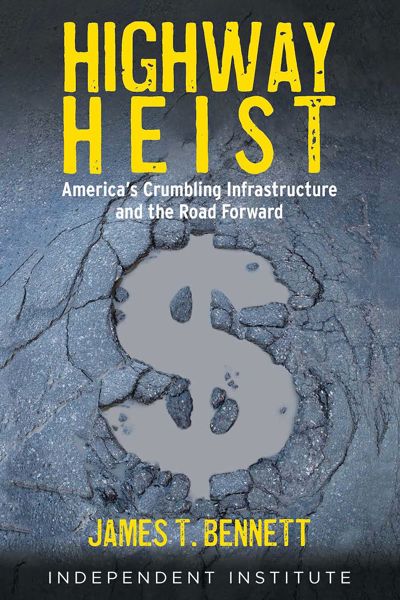
In this eye-opening book, Professor James Bennett guides readers through centuries of one of the most underrated yet widely used aspects of American life—roads.
Relying on history and economic data—and with a humorous and oftentimes sharp tongue—Bennett explains how important America's highways and byways have been to everything from policymaking to everyday life. Crafting America's roads took persuasion, planning—and more taxes than any politician could have dreamed of. And far too often their realization, thanks, in Bennett's view, to flawed interpretations of the power of eminent domain, required destruction, sometimes on a massive scale, of long-established neighborhoods and important cityscapes.
Likewise, the upkeep of America's highways has been the center of many a policy battle, waged by Republicans and Democrats alike. Yes, we all want roads in good working condition—but just how and who will pay for them remain contentious questions.
Bennett argues persuasively that the road forward just might be a second, but more serious, sustained look at, and local experimentation with, private roads and toll roads.Agree or disagree with him, Bennett has written a significant contribution to America's ongoing debate about how her citizens should traverse, from "sea to shining sea," its fruited plain.
Reviews
“James Bennett’s indispensable book Highway Heist critically examines the corruption, waste, and runaway costs of government transportation infrastructure. He reveals how interest groups have long exploited infrastructure spending policies to enrich themselves while subjecting the public to such recurring failures as traffic congestion, dangerous conditions, crumbling roads and bridges, and pork scandals. Instead of such unnecessary problems from government monopolies, Highway Heist shows the viability of private, market-based, enterprising systems in directly serving transport needs, with real accountability, innovative benefits and enormous savings.”
“Whatever your views on highway construction, the remarkable and indispensable book Highway Heist will improve it. Who knew for example that Transportation Secretary John Volpe saved New Orleans’ French Quarter in the 1970s? This fascinating book could not be timelier as state Departments of Transportation throughout America, keeping social objectives in mind, start ramping up infrastructure spending with new Federal funds.”
“One can never know enough history. From Mancur Olson, we know that given enough time, there will be coalitions that prompt interest-group formation and success. So much for the ‘public interest.’ From James Bennett’s book Highway Heist we now have a very readable and informative complement to Olson’s insight, a lively account of how the U.S. highway lobby came to be and what it delivered. The good as well as the bad. We went from muddy roads to the Interstates. And back again. We now have potholed roads in too many places alongside pork projects and congested arteries. Political allocations seemingly end up that way. I cannot think of a better guide to U.S. transportation policy and politics than Highway Heist.”