Named one of the "Best Tech Books of 2017" by Wired Magazine
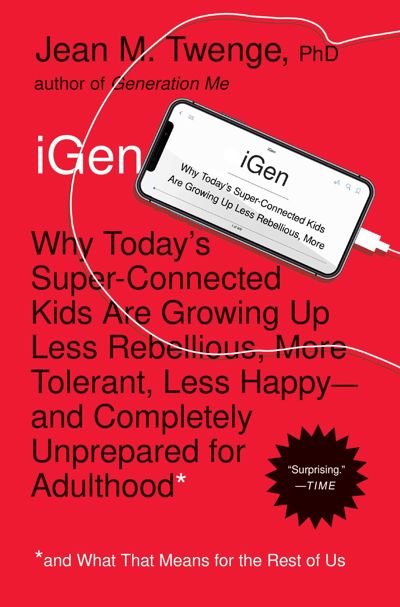
iGen
Why Today's Super-Connected Kids Are Growing Up Less Rebellious, More Tolerant, Less Happy--and Completely Unprepared for Adulthood--and What That Means for the Rest of Us
“We’ve all been desperate to learn what heavy use of social media does to adolescents. Now, thanks to Twenge’s careful analysis, we know: It is making them lonely, anxious, and fragile—especially our girls. If you are a parent, teacher, or employer, you must read this fascinating book.”—Jonathan Haidt, author of The Anxious Generation
Born after 1995, the smartphone generation grew up with cell phones, had an Instagram page before high school, and cannot remember a time before the Internet. They are iGen, and this essential book reveals how these teens and young adults differ from millennials and every other generation in their mental health, social behaviors, and attitudes toward politics and religion.
With generational divides wider than ever, parents, educators, and employers have an urgent need to understand today’s rising generation of teens and young adults.
Born in the mid-1990s up to the mid-2000s, iGen is the first generation to spend their entire adolescence in the age of the smartphone. With social media and texting replacing other activities, iGen spends less time with their friends in person—perhaps contributing to their unprecedented levels of anxiety, depression, and loneliness.
But technology is not the only thing that makes iGen distinct from every generation before them; they are also different in how they spend their time, how they behave, and in their attitudes toward religion, sexuality, and politics. They socialize in completely new ways, reject once sacred social taboos, and want different things from their lives and careers. More than previous generations, they are obsessed with safety, focused on tolerance, and have no patience for inequality.
As this new group of young people grows into adulthood, we all need to understand them: friends and family need to look out for them; businesses must figure out how to recruit them and sell to them; colleges and universities must know how to educate and guide them. And members of iGen also need to understand themselves as they communicate with their elders and explain their views to their older peers. Because where iGen goes, so goes our nation—and the world.
*As seen in Time, USA TODAY, The Atlantic, The Wall Street Journal, and on CBS This Morning, BBC, PBS, CNN, and NPR*
Named one of the "Best Tech Books of 2017" by Wired Magazine
“Stocked with valuable insights, iGen is a game changer and this decade’s ‘must read’ for parents, educators and leaders. Her findings are riveting, her points are compelling, her solutions are invaluable.”
“Jean Twenge collates the data on a generation and not only surprises readers with astonishing discoveries, but also helps us to make sense of what to do with those discoveries. This book is a must-read for anyone interested in understanding students.”
“The reigning expert on generational change weighs in on the iGen, making a case for dramatic changes in just the last five years. Few accounts have seemed more sensational, and few have seemed more true.”