“How, between the covers of a single volume, could one hope to illuminate the vast sea of moral, intellectual, and political failures that add up to modern egalitarianism? Only by combining the expertise and insights of historians, economists, political scientists, philosophers, legal scholars and more. With the book In All Fairness, the Independent Institute has done so brilliantly. Each author’s contribution stands on its own and can be read with profit. Taken together, they complement each other to create a whole that far exceeds the sum of its parts.”
Description
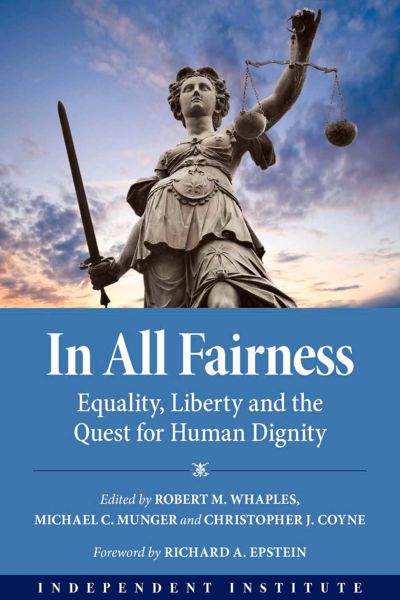
Has growing concern about inequality led to proposals to remake American society according to ill-conceived and coercive "egalitarian" measures that are fundamentally unjust and harmful?
This unique book reveals the modern romance with equality of outcomes as destructive folly. Those elites and bureaucrats who advocate such notions claim that they champion the poor—but more often than not the nostrums of this managerial class undermine, rather than advance, economic and civil liberties, mass prosperity and human well-being.
The authors of In All Fairness challenge all of the prevailing "egalitarian ideas," including the claim that market-based societies are riven by the social injustice of inequity in the first place. After all, an economy thrives with a division of labor that allows individuals who are unequal in interests and talents to pursue their own unique goals. Looked at in this way, equality is far more widespread than misplaced rhetoric might lead one to expect—as factual data show.
But it is an equality of a particularly valuable type—one arrived at, not by top-down, oilgarchic attempts to impose economic uniformity, but by our respecting inviolable rules of fair play and the dignity of each person, a dignity that requires everyone to respect the voluntary transactions of others. This approach holds equity, liberty, diversity, and prosperity together. Would we want it any other way in America and anywhere around the world?
The authors draw on economics, philosophy, religion, law, political science, and history to provide answers to a perennial question that especially agitates the American public today: Can the coercive powers of the state be used to achieve a kind of arithmetic equality? The authors, each in their own way, make a strong case that such powers should never be used in this fashion.
Love inequality or loathe it, In All Fairness is full of key insights about the connections among fairness, liberty, equality and the quest for human dignity. You won’t think about wealth and poverty, equality and inequality, in the same way ever again.
Reviews
“Fairness counts among humankind’s most fundamental social desiderata—demanded even by small children on the playing field. The difficulty is that it is easier to say what fairness is than to determine what is fair. The many faceted book In All Fairness, edited by Robert M. Whaples, Michael C. Munger, and Christopher J. Coyne, does justice to the complexity of the topic in its historical, philosophical, and economic dimensions. Anyone who has ever been inclined to say ‘but that’s just not fair’—which includes just about all of us—will find enlightenment and information in this thoughtfully compiled, instructive, and constructive book.”
“The authors of the timely book, In All Fairness: Equality, Liberty and the Quest for Human Dignity, edited by Robert M. Whaples, Michael C. Munger, and Christopher J. Coyne, dig creatively into the roots of inequality, drawing from philosophy, economics, and religion going way back in human history. This fascinating book shows that realizing proposed egalitarian wealth or income distributions requires a great deal of coercive power, unfairly affects ‘The Forgotten Man,’ and breeds unintended consequences. The book rightly stresses equality of opportunity achieved through economic freedom over equality of outcomes.”
“The beautiful book In All Fairness describes how rapidly growing efforts to impose equality of outcomes necessarily damages everyone’s personal and economic freedom, creates harmful social and cultural divisions, and depresses economic growth that could give millions of people a better life. You will benefit enormously from reading this book, irrespective of where you stand on the debate about inequality.”