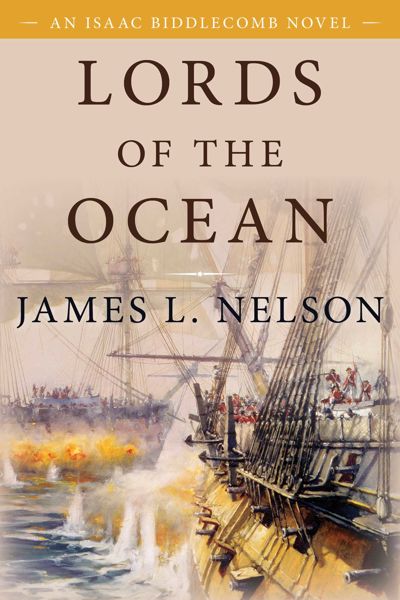
Nelson knows sailing, and he knows people. In Biddlecomb he has an all-too-human hero willing to step over any barrier to keep the British at bay and his own career on track.
Description
James L. Nelson's Isaac Biddlecomb series has brought to life a never-before-seen side of America's war for independence. With the expertise of a seasoned mariner, a historian's vivid attention to detail, and a natural gift for sensational storytelling, "the American counterpart to Patrick O'Brian" (David Brink) carries us along on his bold and stirring course through history.
After ferrying General George Washington's troops across the East River and through the hell known as the Battle of Long Island, Captain Isaac Biddlecomb receives a monumental order. He is to transport to France the most powerful secret weapon in the country's arsenal—scientist, philosopher, and spirit of the enlightenment Dr. Benjamin Franklin. With a new team of men forging through the wintry North Atlantic and braving the cordon of the Royal Navy, Biddlecomb's seemingly simple mission is just the first volley in a grand scheme: to topple France's neutrality by gaining its vital support, and turn the colonial uprising into a full-scale world war for freedom.
Reviews
The fourth volume of Nelson's Revolution at Sea saga covers the period from the Declaration of Independence to the autumn of 1777, which leaves six more years of the Revolution to occupy several additional volumes. Nelson continues to put Isaac Biddlecomb in the center of the historical stage. Biddlecomb conveys Benjamin Franklin to France, receives a salute to the Grand Union flag, and then embarks on a somewhat checkered career of raiding British commerce in British home waters. All of this makes for a real page-turner, with plenty of first-class fight scenes for aficionados of sailing warfare. Some of those scenes are almost comic, such as the spectacle of both Biddlecomb and a traitorous American simultaneously trying to rescue some of Isaac's crew from Bristol Harbor, while others are strictly edge-of-the-seat affairs. Keenly aware of the plot possibilities offered by the events of history and the technology of sailing ships, Nelson continues to earn the loyalty of his steadfast readers.
James Nelson is a master of his period and the English language. . . . Authenticity runs throughout the book, carrying total conviction. . . . Nelson writes with the eagerness of a young man sailing his first command.
Nelson’s seagoing experience is evident in his clear, convincing description. . . . The characters are strong and realistic, the plot and action believable and brisk . . . a fine adventure series.