*"This is a stunning, little-known story, and a welcome volume."
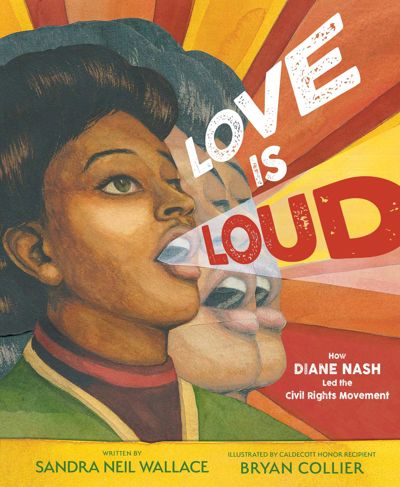
Love Is Loud
How Diane Nash Led the Civil Rights Movement
Four starred reviews!
Meet Diane Nash, a civil rights leader who worked alongside Martin Luther King Jr. and John Lewis, in this “poignant and powerful” (Kirkus Reviews, starred review) nonfiction picture book that is “a stunning, little-known story, and a welcome volume” (School Library Journal, starred review) that “highlights major moments in Nash’s life” (The Horn Book, starred review).
Diane grew up in the southside of Chicago in the 1940s. As a university student, she visited the Tennessee State Fair in 1959. Shocked to see a bathroom sign that read For Colored Women, Diane learned that segregation in the South went beyond schools—it was part of daily life. She decided to fight back, not with anger or violence, but with strong words of truth and action.
Finding a group of like-minded students, including student preacher John Lewis, Diane took command of the Nashville Movement. They sat at the lunch counters where only white people were allowed and got arrested, day after day. Leading thousands of marchers to the courthouse, Diane convinced the mayor to integrate lunch counters. Then, she took on the Freedom Rides to integrate bus travel, garnering support from Martin Luther King Jr. and then the president himself—John F. Kennedy.
*"This is a stunning, little-known story, and a welcome volume."
*"A poignant and powerful portrayal of the life and work of an unsung civil rights activist....Wallace’s text lends buoyancy to the narrative, making it a memorable read-aloud."
*"Wallace’s emotive second-person text condenses Nash’s extensive activism into an inspiring meditation on love as the heart of justice, while Collier’s watercolor and collage illustrations bring artful dimension to Nash’s nonviolent resistance."
*“During the 1960s, Diane Nash was one of the most influential and effective leaders of the Civil Rights Movement, yet most people don’t know who she is.” Wallace’s latest picture-book collaboration with Collier seeks to correct that ....the book opens with images of Nash’s parents cradling her as a baby and then of Nash, as a small child, being hugged by her grandmother, highlighting the love that encouraged her activism.