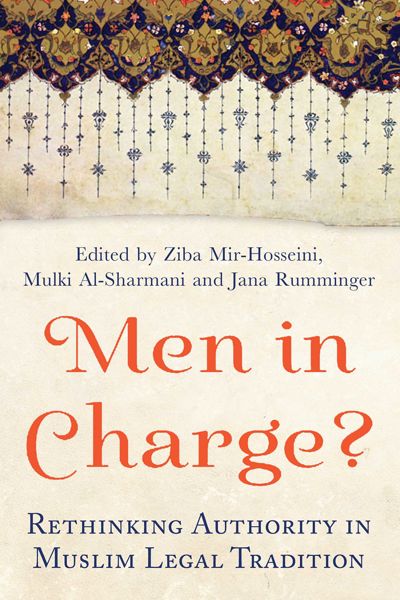
'Men in Charge? is bound to be a key scholarly text for anyone researching or studying law or Islam in general. It is a necessary book, one which is carefully designed to combat misconceptions and prejudice, and one which, most importantly, has a practical focus: all of the book’s contributors are writing for change. In reminding us that there is a difference between the Qur’an and the subsequent misogynist interpretations at the hands of certain actors (“Shari’ah court judges, community leaders, imams, women in leadership positions who perpetuate patriarchal structures of power, etc”), these authors pave the way for a brighter and fairer future for Muslim women.'
Description
Both Muslims and non-Muslims see women in most Muslim countries as suffering from social, economic, and political discrimination, treated by law and society as second-class citizens subject to male authority. This discrimination is attributed to Islam and Islamic law, and since the late 19th century there has been a mass of literature tackling this issue.
Recently, exciting new feminist research has been challenging gender discrimination and male authority from within Islamic legal tradition: this book presents some important results from that research. The contributors all engage critically with two central juristic concepts; rooted in the Qur’an, they lie at the basis of this discrimination. One refers to a husband’s authority over his wife, his financial responsibility toward her, and his superior status and rights. The other is male family members’ right and duty of guardianship over female members (e.g., fathers over daughters when entering into marriage contracts) and the privileging of fathers over mothers in guardianship rights over their children.
The contributors, brought together by the Musawah global movement for equality and justice in the Muslim family, include Omaima Abou-Bakr, Asma Lamrabet, Ayesha Chaudhry, Sa‘diyya Shaikh, Lynn Welchman, Marwa Sharefeldin, Lena Larsen and Amina Wadud.
Reviews
‘A powerful new weapon for Islamic gender warriors: a book examining how a single verse in the Quran became the basis for laws across the Islamic world asserting Muslim men’s authority – and even superiority – over women.’
‘Brimming with fact and insight, these critical and constructive essays by a global array of scholars and reformers focus our attention on how patriarchy functions in Muslim texts and contexts, and how it can be challenged. Their distinctive analyses converge and diverge, leading the reader to a new awareness of the range and power of Muslim feminist thought in the twenty-first century.’
‘Bar none, this is the best treatment of women and Islamic law that I have read in the past twenty years ... profound, eye-opening and even exhilarating. It is difficult for me to take seriously any student or scholar dealing with the subject of guardianship of men over women in Islam unless, or until, they have read and digested this book.’