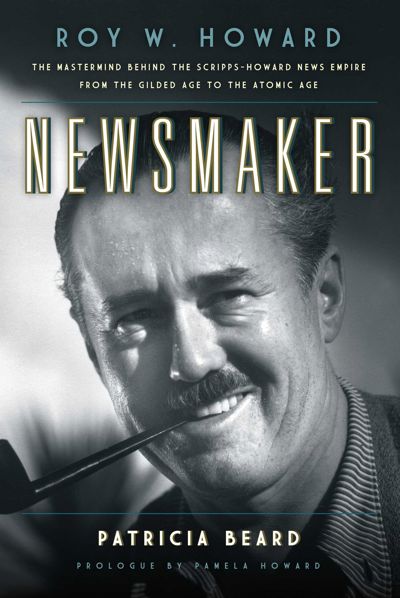
Newsmaker

Roy W. Howard, the Mastermind Behind the Scripps-Howard News Empire From the Gilded Age to the Atomic Age

Description

This is the story of one of the most important American newspapermen of the twentieth century. Roy Howard rose to prominence at the height of newspapers’ power and became a leader in the evolution of print news starting in 1908—when E. W. Scripps appointed him head of the fledgling United Press at age 25—through his tenure as chairman of the Scripps-Howard empire until 1952. As Howard expanded and modernized the business, he landed some of the most important scoops between World War I and the Korean War. Ebullient, likeable, and outgoing, he headed one of only two coast-to-coast news concerns—Hearst being the other. An advisor to presidents and prime ministers, Howard witnessed the most significant events of the time. A 1930 front-page New York Times article named him one of the 59 men who “rule” America, with John D. Rockefeller topping the list. Time magazine put him on the cover. The Saturday Evening Post lionized him. Even his enemies gave him plenty of coverage: The New Yorker excoriated him in a four-part series, although the author admitted that Howard’s and Hearst’s were the only American newspaper publishers whose photographs the average newspaper reader would recognize. With exclusive, first-time access to thousands of previously unpublished documents in the privately held Howard family archives, author Patricia Beard opens a rich mine of stories from one of the most volatile periods in history as revealed by the head of a newspaper empire at a time when the press both made and broke the news.
Reviews

Roy Howard was one of the most influential newspaper men of the twentieth century. At twenty-five he became general manager of what was then United Press and by thirty-nine he was chairman of the newly renamed Scripps-Howard news empire. He was central to the reporting of two world wars, the Depression, and the creation of the American century. Patricia Beard’s Newsmaker draws on a treasure trove of personal papers to create the full picture of a man who by dint of will and determination helped create a world of journalism that lasted decades. Journalism is always evolving and much can be learned from Beard’s lively and illuminating description of a man who was at the center of global events.

Jeffrey Herbst, president and CEO of the Newseum

Roy Howard was a key player in the golden age of newspaper journalism. From the early twentieth century into the nineteen sixties, his creativity, energy and passion fueled a major newspaper chain, Scripps-Howard, an international news syndicate, United Press, and his own news-making interviews with notables, including Hitler and Stalin in the same week of 1936. He was a confidant of every president from Hoover and FDR to Eisenhower. Newsmaker captures Howard’s flair for living, his innovative accomplishments and his impact on his times.

James Hoge, former publisher of the New York Daily News and former editor and publisher of the Chicago Sun–Times

Roy Howard is one of the most remarkable journalism leaders of the twentieth century. He lived the life of three people. For years I have believed that Howard’s story was worthy of a book, or several. Patricia Beard has taken on the challenge and written an extraordinary biography.

Bradley J. Hamm, Dean of Medill School of Journalism, Media, Integrated Marketing Communications—Northwestern University

For much of the twentieth century Roy Howard was one of the nation’s dominant media barons. In Newsmaker, Patricia Beard shows why Howard and the Scripps Howard media empire mattered, and how their work shaped America. It’s a detailed, entertaining read straight out of The Front Page.

Ray Locker, author of Nixon’s Gamble and Washington enterprise editor of USA TODAY

More United States

More History