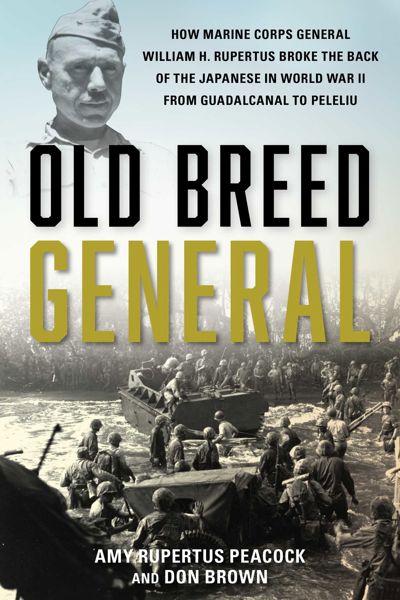
Old Breed General
How Marine Corps General William H. Rupertus Broke the Back of the Japanese in World War II from Guadalcanal to Peleliu
Marine general William H. Rupertus is best known today for writing the Corps’ Rifleman’s Creed, which begins, “This is my rifle. There are many like it, but this one is mine”—which has been made famous by films such as Full Metal Jacket and Jarhead. Rupertus was one of the outstanding Marines of the twentieth century, standing alongside men such as Smedley Butler, Chesty Puller, and Arthur Vandegrift, but he died in 1945, so his story has never been told.
Rupertus “made his bones” in the USMC’s “savage wars of peace” before World War II: Haiti for three years after World War I, China in 1929 (where he lost his wife and children to the scarlet fever epidemic) and again in 1937 (where he witnessed the beginning of Japan’s war against China that turned into the Pacific War of World War II).
In World War II, Rupertus commanded during four important battles: Tulagi and Henderson Field during the Guadalcanal campaign; the Battle of Cape Gloucester; and Peleliu. It was a series of blistering battles—and ultimately victories—that helped break the back of the Japanese and pave the way for American victory. In the course of these battles, Rupertus became the Patton of the Pacific—ruthless in war, always on the attack, merciless against the enemy, undefeated in battles—even as he proved himself very much like Eisenhower, suavely diplomatic and able to balance war with politics. These skills allowed Rupertus to crush the enemy in the malaria-infested jungles of the Pacific and personally escort Eleanor Roosevelt on her tour of the Pacific.
Old Breed General is the biography of Rupertus and the story of the Marines at war in the Pacific. This is an American story of love, loss, shock, horror, tragedy, and triumph that focuses on Rupertus and the 1st Marine Division in World War II, but which resonates through the 1st, to Chosin in Korea and James Mattis’s command in Iraq.
"All present-day Marines should read this book. Gen. Rupertus was the one of the most highly experienced leaders of WWII. Before the Peleliu nightmare, he had served in WWI, the Banana Wars, 1930's Peking, and alongside the Maoist-oriented Raiders on Guadalcanal. At Peleliu, his 1st Marine Division then faced the most difficult terrain of WWII. Umurbrogol Mountain was not just covered by a maze of caves and jagged coral, but fully hollowed out by erosion. So, while Chesty Pullers' 1st Marines were trying to climb this mountain to quiet the Japanese artillery at its top before the 25,000 Japanese on another Palau island could counterattack, Nipponese soldiers kept popping up behind them. Through on-the-job training, Chesty's boys soon learned how to move across severely broken terrain in a loosely controlled line of semi-autonomous fireteams. This nontraditional skill would later allow them (under a different commander) to occupy Shuri Castle atop Okinawa's infamous defense line. But their former general Rupertus also deserves some credit for that key WWII victory. He had been the one to develop the Rifleman's Creed. So, he considered each rifleman to have strategic value. Only then could fireteams of this caliber be formed.
As magnificent as that effort was on Peleliu, it had still come with a price. And that island would be remembered as the most costly amphibious landing of WWII. Following Admiral Halsey's suggestion that the Peleliu landing may not have been necessary, Rupertus became widely rumored to have followed too high a tempo of operations. Only recently has the tactical sophistication of Peleliu's defenders been realized. But, Gen. Rupertus' reputation had still been tarnished, and he died of a broken heart three months later. With this book, the record should be set straight. The entire 1st Marine Division had performed exceptionally well at Peleliu and then went on to win the most important engagement of WWII in the Pacific. Rest in peace, fine general. The Corps was so sad about Peleliu's loss of life that it was slow to realize its degree of accomplishment."
"Journalist Peacock and novelist Brown (The Last Fighter Pilot) deliver a comprehensive account of the career of Peacock’s grandfather, Maj. Gen. William H. Rupertus, who wrote the Marine Corps’ “Rifleman’s Creed” and led the 1st Marine Division to key victories at Tulagi, Guadalcanal, Cape Gloucester, and Peleliu. The authors note that Rupertus got an up-close view of the Japanese military while serving with the Marines in China in the 1920s and ’30s and had no illusion that Japan would wage an all-out war against America. Blow-by-blow accounts of the campaign to retake the Pacific focus on Rupertus’s command decisions, including his direction of the landing force at Tulagi; his wrestling with dengue fever while defending Guadalcanal’s airstrip against a major Japanese counteroffensive; and his successful campaign to take control of the airport and clear out entrenched Japanese forces on the island of Peleliu... Peacock and Brown provide plenty of drama and action. This vivid biography gives its subject well-deserved recognition."
NetGalley Review: 5 stars
Last updated on 07 Nov 2021
"This is just a good WWII read!... This book told the detailed story of Marines of the 1st Marine Division "the Old Breed" and their leader Maj.Gen. William Rupertus. The author's tells of the personal side of Rupertus' life, including the loss of his first wife and two children while stationed in China in the 1930's. They go on to give an in-depth look his leadership in the island hopping campaign from Guadalcanal to Peleliu, and some of the smaller, less reported battles of the war. The authors do an great job giving vivid details to events and Rupertus' decision making, One of the author's personal relationship to the General and her access to his personal writings and papers brought the story to life. "