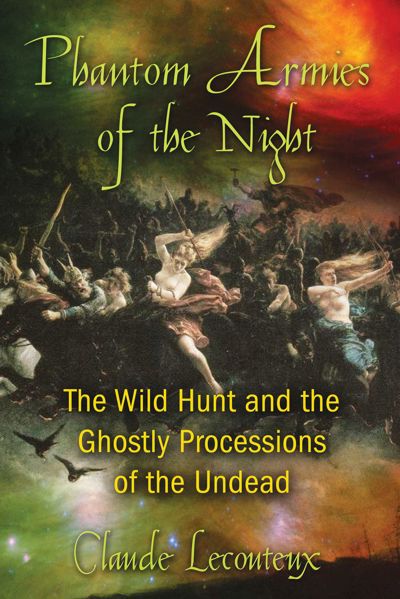
Phantom Armies of the Night

The Wild Hunt and the Ghostly Processions of the Undead

Description

An exploration of the many forms of the ancient myth of the Wild Hunt and its influence in pagan and early Christian Europe

• Recounts the myriad variations of this legend, from the Cursed Huntsman and King Herla to phantom armies and vast processions of sinners and demons

• Explains how this belief was an integral part of the pagan worldview and was thus employed by the church to spread Christian doctrine

• Reveals how the secret societies of medieval Europe reenacted these ghostly processions for soul travel and prophecies of impending death

Once upon a time a phenomenon existed in medieval Europe that continuously fueled local lore: during the long winter nights a strange and unknown troop could be heard passing outside over the land or through the air. Anyone caught by surprise in the open fields or depths of the woods would see a bizarre procession of demons, giants, hounds, ladies of the night, soldiers, and knights, some covered in blood and others carrying their heads beneath their arms. This was the Wild or Infernal Hunt, the host of the damned, the phantom army of the night--a theme that still inspires poets, writers, and painters to this day. Millennia older than Christianity, this pagan belief was employed by the church to spread their doctrine, with the shapeshifters' and giants of the pagan nightly processions becoming sinners led by demons seeking out unwary souls to add to their retinues. Myth or legend, it represents a belief that has deep roots in Europe, particularly Celtic and Scandinavian countries.

The first scholar to fully examine this myth in each of its myriad forms, Claude Lecouteux strips away the Christian gloss and shows how the Wild Hunt was an integral part of the pagan worldview and the structure of their societies. Additionally, he looks at how secret societies of medieval Europe reenacted these ghostly processions through cult rituals culminating in masquerades and carnival-like cavalcades often associated with astral doubles, visions of the afterlife, belief in multiple souls, and prophecies of impending death. He reveals how the nearly infinite variations of this myth are a still living, evolving tradition that offers us a window into the world in which our ancestors lived.
About the author(s)

Claude Lecouteux (1943–2025) was a professor emeritus of medieval literature and civilization at the Sorbonne and author of numerous books on medieval and pagan afterlife beliefs and magic, including The Book of Grimoires, Dictionary of Ancient Magic Words and Spells, and The Tradition of Household Spirits.

Reviews

“Claude Lecouteux marshals what must be a virtually complete recounting of stories from throughout Europe involving nocturnal sightings of the Army of the Dead, also known as the Wild Hunt, and traces their thematic origins from pre-Christian times through the filter of the medieval church. His primary sources are exhaustive, ranging from the medieval period to 20th-century accounts by various authors along with church records and folktales. His secondary sources draw extensively on scholarship, particularly from France and Germany. The connection of the figure now known as Harlequin and other figures to rites for the dead is particularly well presented. The Wild Hunt was clearly associated with the spirits of the dead but also with fertility, fecundity, and certain times of the year. Lecouteux explores these and many more aspects of a civilization that both lies behind us and is in faint form still present.”

“One of the most frightening and persistent visions recorded throughout Indo-European history, legend, and folklore is the spectral array of the Wild Hunt. Claude Lecouteux’s brilliant scholarly detective work results in the definitive study of these ghastly processions that have haunted the night skies of Europe for millennia. Phantom Armies of the Night is teeming with tales that will fascinate, delight, and terrify--often all at once.

“This book is an excellent jumping-off point for scholars wishing to untangle the lines between early Christianity as it blended and then separated from European Paganism. Excellent scholarship along with thought provoking legends and a light hand on interpretation makes this an outstanding addition to a historian’s library.”

“...clearly associated with demons and spirits of the dead and the author describes this folklore with eerie tales that will fascinate you.”

More by Claude Lecouteux

More Folklore & Mythology

More Social Science

More All Other Nonfiction

More Customs & Traditions

More Paganism & Neo-Paganism

More Religion