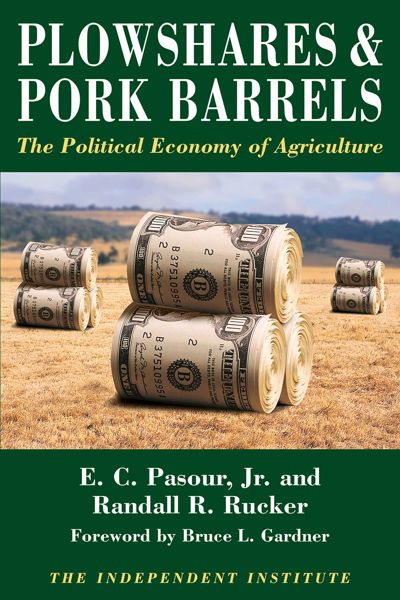
"American consumers of farm products and taxpayers pay a heavy price for government policies and programs that subsidize farmers, and at the same time, regulate them in ways that stifle free trade and reduce the efficiency of agricultural production. These are the principal conclusions of a brilliantly researched and sprightly written book, Plowshares & Pork Barrels. This book is especially timely and important and I believe it will become an encyclopedic reference source for anyone wishing to better understand this vital sector of our economy."
Description
Plowshares & Pork Barrels provides the historical and economic context necessary to make sense of U.S. agricultural policy and examines possible market-based alternatives that could benefit consumers and ensure the advancement of American agriculture in an increasingly interdependent global economy.
Established in 1860, the U.S. Department of Agriculture has grown without cease and is now the most entrenched of all federal agencies. The Farm Bills signed by Presidents Bill Clinton in 1996 and George W. Bush in 2002 only served to further expand this byzantine system.
Economists are nearly unanimous in their denunciation of this wasteful and pernicious web of politics. Subsidies for not growing crops are so notorious that they have been the object of biting political satire since their introduction in the 1930s. However, few books have critically analyzed government farm programs in their entirety like Plowshares & Pork Barrels.
Reviews
"The superb book, Plowshares & Pork Barrels, by Pasour and Rucker, is both analytically rigorous and readable. It is the single best guide available to the historical path and complexities of U.S. agricultural policies."
"Plowshares & Pork Barrels is a wondrous history of farm pork and employment at the U.S. Agriculture Department."
"Plowshares & Pork Barrels combines a detailed institutional understanding of American agricultural policy with rigorous analysis of the underlying political economy. It unravels the seemingly convoluted web of governmental programs by exposing the interests of the various groups—farmers, politicians, bureaucrats, and agribusiness ?rms—who stand to benefit. This excellent book should be read by all those interested in agricultural policy including economists, environmentalists, lawyers, political scientists, and policymakers, as well as the public at large."