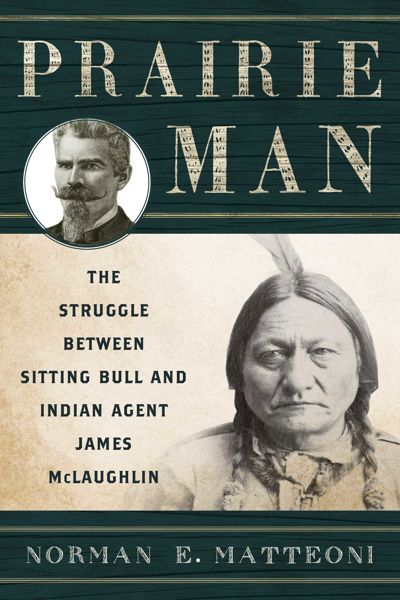
Prairie Man

The Struggle between Sitting Bull and Indian Agent James McLaughlin

Description

One week after the infamous June 1876 Battle of the Little Big Horn, when news of the defeat of General George Armstrong Custer and his 7th Cavalry troops reached the American public, Sitting Bull became the most wanted hostile Indian in America. He had resisted the United States’ intrusions into Lakota prairie land for years, refused to sign treaties, and called for a gathering of tribes at Little Big Horn. He epitomized resistance.
Sitting Bull’s role at Little Big Horn has been the subject of hundreds of historical works, but while Sitting Bull was in fact present, he did not engage in the battle. The conflict with Custer was a benchmark to the subsequent events. There are other battles than those of war, and the conflict between Sitting Bull and Indian Agent James McLaughlin was one of those battles. Theirs was a fight over the hearts and minds of the Lakota.

U.S. Government policy toward Native Americans after Little Big Horn was to give them a makeover as Americans after finally and firmly displacing them from their lands. They were to be reconstituted as Christian, civilized and made farmers. Sitting Bull, when forced to accept reservation life, understood who was in control, but his view of reservation life was very different from that of the Indian Bureau and its agents. His people’s birth right was their native heritage and culture. Although redrawn by the Government, he believed that the prairie land still held a special meaning of place for the Lakota. Those in power dictated a contrary view – with the closing of the frontier, the Indian was challenged to accept the white road or vanish, in the case of the Lakota, that position was given personification in the form of Agent James McLaughlin. This book explores the story within their conflict and offers new perspectives and insights.

Reviews

Lawyer Matteoni presents the parallel lives of Dakota chief Sitting Bull and Indian agent James McLaughlin, two men who would ultimately clash in the Dakota prairie country. The volume begins with the Minnesota River Valley uprisings of the 1860s, documenting the ensuing conflict between the U.S. government and the residents of the Northern Plains. Sitting Bull’s life is revealed beyond the context of Gen. Custer’s defeat at the Battle of Little Bighorn as the author documents Sitting Bull’s exodus to Canada, continued resistance to reservation life, metropolitan tours with Buffalo Bill and Annie Oakley, and controversial death after McLaughlin ordered his arrest. Matteoni mines McLaughlin’s writings, government treaties, and later biographies of Sitting Bull. . . .The author also utilizes his legal knowledge to provide background to the various treaties broken by the U.S. government, occasionally sprinkling 'interpretive quotations' into the text to give voice to the account. . . .[T]he book achieves an information-rich narrative of latter 19th-century Dakota history. An informative debut for those seeking a focused, detailed portrait of Sitting Bull’s life and the struggle for dominance of the American Plains.
More Indigenous

More 19th Century

More United States

More West