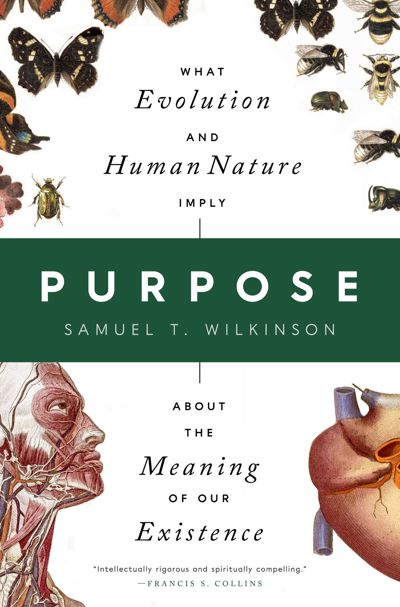
Purpose

What Evolution and Human Nature Imply about the Meaning of Our Existence

Description

By using principles from a variety of scientific disciplines, Yale Professor Samuel Wilkinson provides a framework for human evolution that reveals an overarching purpose to our existence.

Generations have been taught that evolution implies there is no overarching purpose to our existence, that life has no fundamental meaning. We are merely the accumulation of tens of thousands of intricate molecular accidents. Some scientists take this logic one step further, suggesting that evolution is intrinsically atheistic and goes against the concept of God.

But is this true?

By integrating emerging principles from a variety of scientific disciplines—ranging from evolutionary biology to psychology—Yale Professor Samuel Wilkinson provides a framework of evolution that implies not only that there is an overarching purpose to our existence, but what this purpose is.

With respect to our evolution, nature seems to have endowed us with competing dispositions, what Wilkinson calls the dual potential of human nature. We are pulled in different directions: selfishness and altruism, aggression and cooperation, lust and love. When we couple this with the observation that we possess a measure of free will, all this strongly implies there is a universal purpose to our existence.

This purpose, at least one of them, is to choose between the good and evil impulses that nature has created within us. Our life is a test. This is a truth, as old as history it seems, that has been espoused by so many of the world’s religions. From a certain framework, these aspects of human nature—including how evolution shaped us—are evidence for the existence of a God, not against it.

Closely related to this is meaning. What is the meaning of life? Based on the scientific data, it would seem that one such meaning is to develop deep and abiding relationships. At least that is what most people report are the most meaningful aspects of their lives. This is a function of our evolution. It is how we were created.
About the author(s)

Samuel T. Wilkinson is Associate Professor of Psychiatry at Yale University, where he also serves as Associate Director of the Yale Depression Research Program. He received his MD from Johns Hopkins School of Medicine. His articles have been featured in the New York Times, the Washington Post, and the Wall Street Journal. He has been the recipient of many awards, including Top Advancements & Breakthroughs from the Brain and Behavior Research Foundation; Top Ten Psychiatry Papers by the New England Journal of Medicine, the Samuel Novey Writing Prize in Psychological Medicine (Johns Hopkins); the Thomas Detre Award (Yale University); and the Seymour Lustman Award (Yale University).

Reviews

"An essential book by every measure. Beautifully written, superbly researched—and life changing. You will never think of your life, or the earth, or the purpose of each in the same way again!”


Greg McKeown, New York Times bestselling author of Effortless and Essentialism

"If you struggle to reconcile faith and reason, Sam Wilkinson’s profound book Purpose was written for you. You will be left with an understanding of the guiding forces behind human evolution and behavior.”


Arthur C. Brooks, Professor, Harvard Kennedy School and Harvard Business School, and #1 New York Times bestselling author

"Wilkinson makes the case that the evolutionary forces of individual selection and kin selection, operating simultaneously over eons, have produced the best and worst aspects of human nature.  God’s use of evolution in the creation of humanity therefore sets the stage for life to truly test our willingness to choose good over evil as we respond to competing urges. Well-researched, insightful, and provocative."


Laura C. Bridgewater, Professor of Microbiology and Molecular Biology, Brigham Young University

"Into the midst of the often contentious debate about evolution and the meaning of life, Purpose breathes a breath of fresh air. By taking seriously the notion that “everything that is evolved”, Wilkinson highlights how evolution must then be responsible not just for our genetic material, but also for the apparent dual nature of human nature—the tension between selfishness and altruism or between aggression and cooperation. These aspects of human nature suggest that, while the steps of evolution are random, the higher order principles that guide evolution have all the apparent hallmarks of having a clear purpose. I highly recommend this to those seeking a clear and hopeful perspective on how modern science can help us pursue a meaningful life.”


Troy Van Voorhis, Professor at MIT and author of Certainty: Is Science All You Need?

More by Samuel T. Wilkinson

More Evolution

More Life Sciences

More Science

More Social Psychology

More Psychology

More All Other Nonfiction

More Ethics

More Christian Theology

More Religion