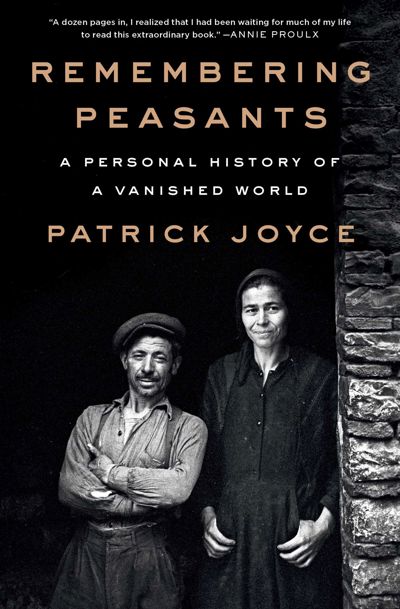
Remembering Peasants

A Personal History of a Vanished World

Description

“I had been waiting for much of my life to read this extraordinary book…there are clues and messages for every fortunate reader who picks it up.” —Annie Proulx

*A New York Times Book Review Editors’ Choice*

A landmark history of the peasant experience, exploring a now neglected way of life that once encompassed most of humanity, but is rapidly vanishing in our time.

“What the skeleton is to anatomy, the peasant is to history, its essential hidden support.”

For over the past century and a half, and most notably over the last seventy years, the world has become increasingly urban, and the peasant way of life—the dominant way of life for humanity since agriculture began well over 6,000 years ago—is disappearing. In this vital history of peasantry, social historian Patrick Joyce aims to tell the story of this lost world and its people, and how we can commemorate their way of life. In one sense, this is a global history, ambitious in scope, taking us from the urbanization of the early 19th century to the present day. But more specifically, Joyce’s focus is the demise of the European peasantry and of their rites, traditions, and beliefs.

Alongside this he brings in stories of individuals as well as places, including his own family, and looks at how peasants and their ways of life have been memorialized in photographs, literature, and in museums. Joyce explores a people whose voice is vastly underrepresented, and is usually mediated through others, in human history—and now peasants are vanishing in one of the greatest historical transformations of our time.

Written with the skill and authority of a great historian, Remembering Peasants is a “first-class work” (Kirkus Reviews), a richly complex and passionate history written with exquisite care. It is also deeply resonant, as Joyce shines a light on people whose knowledge of the land is being irretrievably lost during our critical time of climate crisis and the rise of industrial agriculture. Enlightening, timely, and vitally important, this book commemorates an extraordinary culture whose impact on history—and the future—remains profoundly relevant.

About the author(s)

Patrick Joyce is Emeritus Professor of History at University of Manchester. He is a leading British social historian and has long been a radical and influential voice in debates on the politics and future of social and cultural history. Joyce has written and edited numerous books of social and political history, including The Rule of Freedom, Visions of the People, and The State of Freedom. He is also the author of the memoir Going to My Father’s House, a meditation on the complex questions of immigration, home, and nation. The son of Irish immigrants, Joyce was raised in London and resides beside the Peak District in England.

Reviews

“A dozen pages in I realized that I had been waiting for much of my life to read this extraordinary book. Anyone who has ever tried to unravel the intertwined skeins of ancestry, sociology, music, geography and history will gape at Joyce’s skill. On almost every page the reader gets a jolt, a palpable sensation of immersion in the disappeared world of peasantry. A central part of the book is Joyce’s own family’s peasant past. I too, like many people, am only two generations and one language away from these ancestors. Because the time of the peasants is still palpable there are clues and messages here for every fortunate reader who picks up this book.” —Annie Proulx

Nominated for the Cundill History Prize

“A first-class work combining social history and ethnohistory with an unerring sense for a good story.” Kirkus (starred review)

“An insightful and evocative homage to the peasant way of life… Readers will be enthralled.”Publishers Weekly (starred review) 
 
“[Joyce] rages against the amnesia hardwired into today's 'all consuming' present... A loving and unconventional work of genealogy, and a melancholic elegy for bygone ways of being.” Booklist
 

“[A] moving and sensitive rumination... Joyce shows how the supreme value of the peasant is generational survival: The great task is to hand on to the child the land the peasant has inherited, making one’s own existence a kind of interlude between past and future. His beautifully written book is equally in-between, haunted by the ghosts of the dead but also full of the warmth of human sympathy.”The New York Times Book Review

"In this moving elegy to a lost way of life, Joyce unearths records that recount his own family’s rural Irish roots,...[a]feat of storytelling." —The New York Times 

“In this elegiac history, Joyce presents a painstaking account of a way of life to which, until recently, the vast majority of humanity was bound... The relative absence of peasants from the historical record, and the blinding speed with which they seem to have disappeared, prompt a moving final essay on the urgency of preserving our collective past.” The New Yorker

“Books such as Remembering Peasants are landmarks and waymarkers…This is important, vital writing and study. The level of craftsmanship in the book is evident, but so too is its heart and soul. Reading it, I was changed and charged... Joyce is essential reading for anyone who cares about our shared past. A profound book.” The Irish Times

More by Patrick Joyce

More Civilization

More History

More Europe

More Rural

More Sociology

More Social Science

More All Other Nonfiction