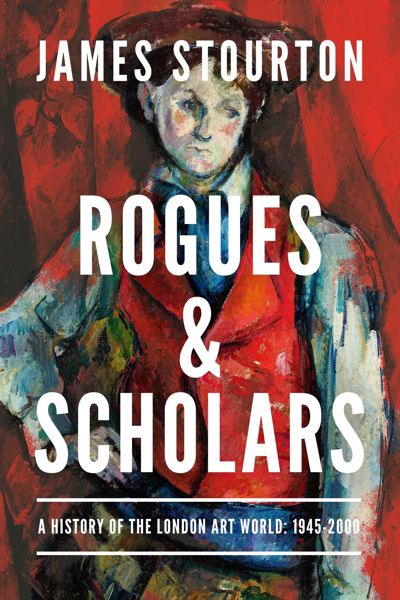
Rogues and Scholars

A History of the London Art World: 1945-2000

Description

A colorful and fast-moving account of how postwar London became the global center of the art market—a story of Impressionist masterpieces, dodgy dealers, and ground-breaking financial transactions.

On October 15, 1958, Sotheby's of Bond Street staged an "event sale” of seven Impressionist paintings belonging to Erwin Goldschmidt: three Manets, two Cézannes, one Van Gogh, and a Renoir. Kirk Douglas, Anthony Quinn, and Somerset Maugham were there as celebrity guests. The seven lots went for £781,000—at the time the highest price for a single sale. The event established London as the world center of the art market and Sotheby's as an international auction house. It began a shift in power from the dealers to the auctioneers and paved the way for Impressionist paintings to dominate the market for the next forty years.

Sotheby's had pulled off a massive coup by capturing the Impressionist market from Paris and New York—and now began its inexorable rise, opening offices all over the world. A huge expansion of the market followed, accompanied by rocketing prices, colorful scandals, and legal dramas. London transformed itself from a fusty place of old master painting sales to a revitalized center of contemporary art, crowned by the opening of Tate Modern in 2000. The Tate Modern successfully united new (and mostly foreign) money in London with the art world, offering its patrons a ready-made sophisticated social milieu alongside dealers in contemporary art.

In a vibrant and briskly-paced style, James Stourton tells the story of the London art market from the immediate postwar period to the turn of the millennium. While Sotheby's is the lynchpin of this story, Stourton populates his narrative with a glorious rogue's gallery of eccentric scholars, clever amateurs, brilliant emigrés, and stylish grandees with a flair for the deal.
About the author(s)

James Stourton is a British art historian, a former chairman of Sotheby's UK, and the author of Kenneth Clark and Great Houses of London. Stourton frequently lectures to Cambridge University's History of Art Faculty, Sotheby's Institute of Education, and The Art Fund. He also sits on the Heritage Memorial Fund, a government panel that meets to decide what constitutes heritage and should be saved for the Britain nation. He lives in London.

Reviews

In Rogues and Scholars, James Stourton discusses how postwar London briefly became the center of the global art market. This is an absorbing story of how small dealers and experts were gradually replaced by large auction houses. If you find yourself paying attention to the stories about the high prices paid at art auctions, you will not want to miss this book.

The Christian Science Monitor

“An erudite and authoritative history of the London art market from World War II to our century. Outstanding in its own field, Rogues and Scholars nears Anthony Bourdain’s tell-all Kitchen Confidential.”

"This rollicking history of the modern London art market takes us from World War II to the present day, charting the shift from a business of decorous private transactions to the glitz, hype and rivalry we know today. Stourton, a longtime director at Sotheby’s UK, brings an insider’s authority to this story of big money, bigger egos and great art."

New York Times Book Review

 Early Praise for Rogues and Scholars:

"With panache and characteristically elegant penmanship, James Stourton throws open the doors to a riveting chapter in the history of art in which glamorous eccentricities, serious scholarship and a good deal of swindling cohabit. It is a story of gentlemen and of crooks, told through witty firsthand accounts about colorful characters sailing dangerously close to the wind. Stourton brings us a gripping and thoroughly researched chronicle of the post-war art market, punctuated with the occasional ‘you couldn’t make this up’ moment. Rogues & Scholars is just as entertaining as it is educational.”

Wolf Burchard, curator of European Sculpture and Decorative Arts at the Metropolitan Museum of Art

More by James Stourton

More Modern

More History