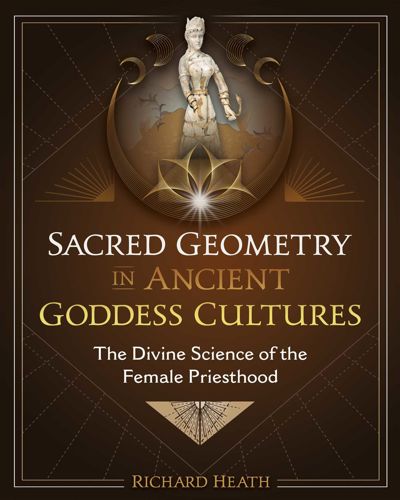
Sacred Geometry in Ancient Goddess Cultures

The Divine Science of the Female Priesthood

Description

Examines the ancient cosmic science of the female megalithic astronomers

• Describes the shared sacred geometry and astronomy knowledge in the megalithic monuments, temples, and secret calendars of the matrilineal cultures of Malta, Gobekli Tepe, and the Minoans of Crete

• Shows how early Christians helped preserve ancient science by encoding it in the rock-cut churches of the Cappadocia region of Turkey

• Explains how Greek myths reveal the transition from matriarchy to patriarchy

Long before Pythagoras and Plato, before arithmetic and Christianity, there existed matrilineal societies around the Mediterranean, led by women with a sophisticated understanding of astronomy and sacred science. In this detailed exploration, Richard Heath decodes the cosmological secrets hidden by ancient goddess-centered cultures on the island of Malta, at Göbekli Tepe in Turkey, and on the Greek island of Crete.

Heath reveals how the female astronomers of Malta built megaliths to study the sun, moon, and planets, counting time as lengths and comparing lengths using geometry. He shows how they encoded their cosmological and astronomical discoveries, their “astronomy of the goddesses,” in the geometries of their temples and monuments. Examining Maltese and Cretan artifacts, including secret calendars, he details how the Minoans of Crete transformed Maltese astronomy into a matriarchal religion based on a Saturnian calendar of 364 days. He also reveals evidence of the precursors of Maltese astronomical knowledge in the monuments of Göbekli Tepe.

Looking at the shift from sacred geometry to arithmetic in ancient Mediterranean cultures, the author parallels this change in mindset with the transition from matriarchal to patriarchal cultures. He reveals how Greek myths present a way to see the matriarchal past through patriarchal eyes, detailing how Saturn’s replacement by Jupiter-Zeus symbolizes the transition from matriarchy to patriarchy. The author examines how the early Christians helped preserve the ancient astronomy of the goddesses, due to its connections to Christ’s cosmological teachings, by encoding this astronomy in the artwork of the rock-cut churches and monasteries of the Cappadocia region of Turkey.

Revealing how our planet—with its specific harmonics and geometries within our star system—is uniquely designed to support intelligent life, the author shows how this divine spiritual truth was known to the ancient astronomers.
About the author(s)

After decades of technical and spiritual training, Richard Heath became interested in megalithic astronomy and its numerical skillset. He has written five books on the sacred use of numbers. In Matrix of Creation he explores those found in the planetary world, in Sacred Number and the Origins of Civilization he explores those important to ancient civilizations, and in Precessional Time and the Evolution of Consciousness he examines the numbers that define the important Ages of the world. In Sacred Number and the Lords of Time he provides an alternative history for megalithic astronomy, and in The Harmonic Origins of the World, he explains how the megalithic discovered planetary harmony through counting lunar months, thus explaining why ancient texts were informed by harmonic numbers. He lives in the Preseli Hills of West Wales.

Reviews

“Richard Heath’s fascinating and highly readable book presents a decoding of the metrology of Göbekli Tepe of 10,000 BCE and advances arguments that support its role as a place for the worship of the Goddess. Although the megaliths of Europe were to come nearly 5,000 years later, the book marshals evidence from mathematics, astronomy, sacred architecture, and tone theory to show that these structures were a successor to Göbekli Tepe. The book disentangles many threads that went into the creation of the Classical Age.”

“Richard Heath’s in-depth study of the sacred science and cosmology of the ancient matrilineal societies around the Mediterranean is a compelling tour de force. Beautifully explained with clear diagrams and tables, the implications of this work are far reaching.”

“In this extraordinary book, Richard Heath synthesizes more than 10,000 years of art, architecture, harmony, geometry, astronomy, and metrology, once again demonstrating the reach, power, and persistence of these perennial traditions.”

“The esoteric knowledge encoded in ancient sacred sites is being revealed now. As the result of more than two hundred years of global archaeology and site analysis using metrology, sacred geometry, and cosmological analysis, surprising insights about sacred places are coming forth. These remarkable findings are brilliantly described in Richard Heath’s Sacred Geometry in Ancient Goddess Cultures. He shows us how Mesolithic priestesses and Neolithic priests designed sacred places to resonate with the powers of Earth in synchronicity with the cycles of the moon, planets, and stars. Then later cultures, such as the Greeks, followed ancient guidance as well as using music, harmony, mythology, and storytelling. As I contemplated these insights pouring out of Heath’s marvelously insightful mind, I felt a bond with these creators; I could feel their joy! This wonderful and beautifully illustrated book invites us to feel Gaia, the sacred feminine of Earth. For me, this ancient lineage can be described as the Matriarchy through Patriarchy into Humanarchy—our return to ecological worship—knowing Earth in our bodies as we contemplate the cosmos.”

More by Richard Heath

More Ancient Mysteries & Controversial Knowledge

More Body, Mind & Spirit

More All Other Nonfiction

More Goddess Worship

More Number Theory

More Mathematics