Praise for What Jefferson Read, Ike Watched, and Obama Tweeted (Regnery, 2013):
“This well-researched and highly readable book is rich in such material, and Mr. Troy is one of those rare creatures seldom sighted in the wilds of the academic-cultural-literary complex — an accomplished scholar who is also a first-rate writer.”--John R. Coyne Jr., The Washington Times
“The book is an entertaining refresher course on the personalities who have filled the White House. Think of it is as beach reading for nerds, more U.S. News & World Report than Us Weekly.”--Betsy Woodruff, National Review
“It’s a must-read for junkies and campaign operatives.”--Jennifer Rubin, Washington Post
“Troy's major contribution is his balanced assessment of how popular culture fundamentally transformed the political game in the last third of the 20th century.”--Robert W. Patterson, The Philadelphia Inquirer
“Everyone should read everything that Tevi Troy writes, so it goes without saying that his new book, What Jefferson Read, Ike Watched, and Obama Tweeted, is worth your while.”--Yuval Levin, NRO: The Corner
Praise for Intellectuals and the American Presidency: Philosophers, Jesters, or Technicians? by Tevi Troy (Rowman & Littlefield, 2002):
“What’s perhaps most surprising about this book is that it took so long for someone to write it. . . . Now comes Tevi Troy to fill the void, and fill it he does.”--Jonathan Yardley, The Washington Post
“Tevi Troy's engaging Intellectuals and the American Presidency chronicles, among much else, FDR's 'brain trust,' the academic sycophants of Kennedy's Camelot, and the thinkers who gave George W. Bush his 'compassionate conservativism' [and] raises questions as old as political philosophy itself: Where should our leaders look for wisdom? Whom should they seek to please?”--The Wall Street Journal
“Intellectuals and the American Presidency” is a lively tale and well told, and certainly not meant for academics only.”--Roger Fontaine,The Washington Times
“Love them or hate them, intellectuals are players in American politics. Good politicians realize this, and act accordingly. Tevi Troy smartly chronicles the surprising successes and occasional humorous failures of presidents who courted America's elusive yet vocal intellectual establishment. This lively and readable study is must-reading for lovers of history and politics alike.”--Jack Valenti, chairman, Motion Picture Association of America
“In fact, intellectuals are so important to the American presidency that U.S. presidents “ignore the intellectuals at their peril.” This is the thesis of Tevi Troy’s important and absorbing book.”--Jason Bertsch, The Public Interest
“In this tightly-written book, Tevi Troy shows that the intellectual’s place in the White House is usually a subordinate one. Presidents use professors for their own purposes, not the other way around.”--John J. Pitney, Jr., Claremont Review of Books
Description
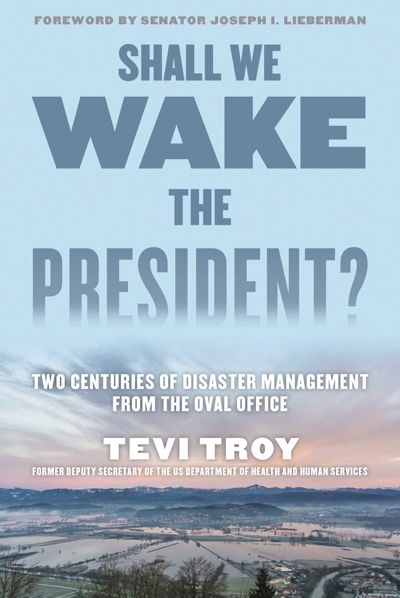
The history of presidential dealings with disasters shows that whatever their ideology, presidents need to be prepared to deal with unexpected crises. In recent years, the expectations have grown as the disasters seem to appear to be coming more frequently. Since 2001, numerous unpredictable crises, including terror attacks, massive storms, and an economic collapse, have shaken Americans to their core. It seems as if technology, for all of its beneficences, also provides mankind with increasingly powerful ways to wreak destruction, including nuclear explosions, bioterror attacks, and cyber-attacks. In addition, instantaneous and incessant communications technologies send us word of disasters taking place anywhere in the nation far more rapidly, giving disasters an immediacy that some may have lacked in the past.
In 21st century America, the eyes of the American people look to the president to lead the response to whatever disasters happen to strike. President Obama and his team learned this and were taken aback by the sheer number of crises that a president needed to deal with, including swine flu, BP’s Macondo oil spill, and the Somali pirates who attacked an American ship. Many of these did not quite reach disaster status, but Obama’s reaction to the constant stream of crises was both revealing and unnerving: “Who thought we were going to have to deal with pirates?”
In Shall We Wake the President?, Tevi Troy, a presidential historian and former senior White House aide and deputy secretary of the Department of Health & Human Services, looks at the evolving role of the president in dealing with disasters, and looks at how our presidents have handled disasters throughout our history. He also looks at the likelihood of similar disasters befalling modern America, and details how smart policies today can help us avoid future crises, or can best react to them should they occur. In addition, he provides information on what individuals can do to prepare for disasters.
This book includes sections on how American presidents have dealt with a variety of disasters, including health crises, terror attacks, economic upheaval, bioterror and cyber-attacks, natural disasters, and civil breakdown. In doing so, Shall We Wake the President? will provide lessons from presidents of the past that will inform policy strategies for presidents of the future.
Genres
Reviews
The art of leadership emerges not during calm, but in crises—21st-century, premodern, episodic, multiple, sudden, simmering, solvable and existential—and never more so in the age of spreading nuclear weapons and instant communications. Tevi Troy’s fascinating new survey of how presidents dealt with disasters and near disasters is both historical and didactic: what has made a president in the past keep calm and yet forceful during an unforeseen challenge—and what can those in government and the public in their daily lives learn about dealing with catastrophes from our successful and not so successful Commanders-in Chief?
Shall We Wake the President? is an entertaining and informative tour of how presidents have responded to disasters, and what our country, including future presidents, should do when disaster strikes again. They should be prepared! Dr. Troy will convince you that farsighted preparation can make our nation stronger and our citizens safer.