"The best book in this genre that I have seen in recent times. The reader has to face the same problems as during a real game. Working diligently with this entertaining work will improve the performance of a wide range of club players. Above all their strategic and analytical skills."
Description
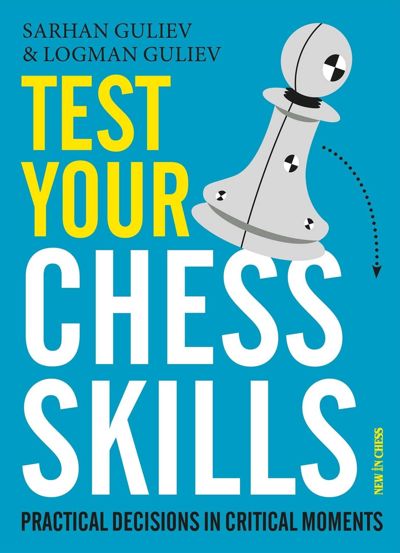
The test positions in this instructive book cover the entire spectrum of what a modern club player should know. The reader is invited to find tactical blows, deep strategic manoeuvres, opening traps, standard endgame plans and other principles in action.
Sarhan Guliev and his brother Logman Guliev have carefully selected the positions from their own games. That is why these puzzles are completely unknown outside the former Soviet Union. The fact that they originated from real games guarantees that the tests are practical, not artificial. The solutions rarely involve spectacular fireworks, as is the case in most chess puzzle books. The solution may be a quiet move or you may be asked for a reasoned evaluation.
In the solutions the Guliev brothers clearly explain the underlying ideas and the principles that are involved. They always offer a general conclusion and have added thoughtprovoking and entertaining aphorisms. In addition there are points to earn with every solution, so students can keep track of their development. Solving the puzzles in this unusual and entertaining book is a most effective way to improve your chess. It will help you to develop a vital skill: the ability to take practical decision in critical moments.
Genres
Reviews
"Do you know the legendary book by Host and Jansa? The Guliev brothers have put together a modern version. This is a puzzle book that seeks to imitate a tournament situation."
"Very original and highly recommended."
"In the 224 positions (from their own practice, so nothing hackneyed) they ask you to decide whether a player is better, worse, equal, winning, hopeless, etc.; to find the strongest move or assess the move played and so on, in other words, it's about decision making. By its nature it's probably more strategical than tactical, although the examples cover pretty much everything: openings, tactics, endgames, surprises, missed wins. It's not a solve-at-a-glance book; the point is to get you to sit down at your board and think as you would during a game. The detailed solutions, which are written in a chatty, personal style, take up about two-thirds of the book and are sprinkled with little homilies, e.g. 'Routine thinking is a great enemy!' and 'Try to look at the position through the eyes of the opponent', stuff everyone should know, but often forgets in the heat of the battle."