The Art of Weaving by Betty Briand should be on your library shelf. Ms. Briand shares her incredibly vast knowledge of weaving in this very impressive book. It is a book for all weavers regardless of their weaving experience. The book gives clear explanations on every aspect of weaving. The author also goes into detail on many different weave structures and give tips on how to approach weaving them. There are also many helpful hints scattered throughout the book to make your weaving successful the first time.
Description
This comprehensive guide to floor loom weaving begins with the basics—parts of the loom, how to wind your warp and dress your loom; how to read and weave drafts—but then goes so much farther, explaining the different types of weaves and how to read and weave from charts, and exploring a variety of weaves in depth. The author covers each topic in detail, with illustrations, photos, and charts to guide you. The first half of the book is devoted to the basics of weaving, and the second part teaches a variety of weave structures and how to use them and adapt them to whatever you want to make. The Art of Weaving is extensive in its scope, and a reference book appropriate for all skill levels.
* Preparing your yarn and threading your floor loom
* Understanding and working from drafts
* Exploring weave structures
* Finishing
* Troubleshooting
Reviews
The Art of Weaving by Betty Briand should be on your library shelf. Ms. Briand shares her incredibly vast knowledge of weaving in this very impressive book. It is a book for all weavers regardless of their weaving experience. The book gives clear explanations on every aspect of weaving. The author also goes into detail on many different weave structures and give tips on how to approach weaving them. There are also many helpful hints scattered throughout the book to make your weaving successful the first time.
In the opening moments of my very first weaving class, my teacher asked me why I wanted to learn to weave. Surprised, I thought a few seconds, then said, “I want to know how to make cloth.” She nodded. “What interests you more, the process or the product?” No need to think about that one. “Definitely process.” “Okay,” she said, “now I know how to teach you.” And so she did.
Fast-forward 11 years to the day The Art of Weaving arrived in the mail. Turns out Betty Briand is a process-of-weaving teacher on steroids. With palpable exuberance and many exclamation points—she is French, after all—her book opens with exhaustive overviews of looms, tools, yarns (did you know there is a yarn made from asbestos?), and the protocol for choosing projects. She talks about the need for physical comfort when weaving, the benefits of keeping project records, and the vital importance of sampling, sampling, sampling. Briand’s masterful dissertation on warp and weft densities introduces the math and science of determining the best possible warp sett and picks per inch for any project. Then she tackles understanding, reading, and creating drawdowns.
The intellectual side of the craft amply covered, she moves on to the mechanical aspects of dressing the loom, from winding warp chains to tying on to the cloth beam and tying up the treadles. Finally, she sits down (comfortably) at the loom—her default model is four shafts—to explain all things shuttle, weft positioning in aid of neat selvedges, the relationship between beat and the hand of the finished fabric, and maintaining warp tension. Briand also addresses preventing, spotting, and correcting common beaming, threading, sleying, and tie-up errors.
And that’s just the first 114 pages.
If the brilliance and breadth of the above dazzle you, wait until Briand takes on the three basic weave structures. In my opinion, hers is the clearest, most extensive, all-in-one-place discussion ever of plain weave, twill, and satin. Unfamiliar with the last because I lack the requisite fifth harness, my smoldering shaft-envy flared—and then cooled when I saw Briand’s draft for four-shaft “false” satin.
With the fundamentals illuminated, Briand breezes on to compound structures (just plain weave with floats, who knew?), lace and deflected weaving, and the many magics of doubleweave. Her grand finale is a section on digesting all this information to break free of published patterns and create your own designs.
For Briand, weaving is fun, an exploration, an excitement, an emotion! I could almost hear her voice, encouraging innovation fueled by a complete understanding of how densities, interlacements (“binding points,” she calls them), yarn weights and colors, and the intended use of the fabric combine to open infinite design possibilities. If you’re a product-focused weaver, The Art of Weaving is an excellent resource to have on hand. If you’re a process-focused weaver, you’ve got to get this book. Like, today.
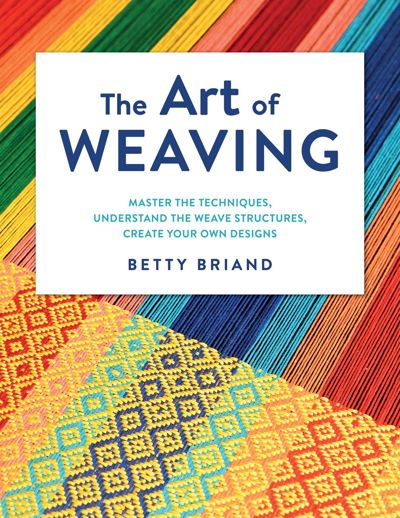
Synopsis: "The Art of Weaving: Master the Techniques, Understand the Weave Structures, Create Your Own Designs" by Betty Briand is a comprehensive instruction guide to floor loom weaving. It begins with the basics (parts of the loom, how to wind your warp and dress your loom; how to read and weave drafts) but then goes so much farther, explaining the different types of weaves and how to read and weave from charts, and exploring a variety of weaves in depth.
"The Art of Weaving" covers each topic in detail, with illustrations, photos, and charts to guide you. The first half of the book is devoted to the basics of weaving, and the second part teaches a variety of weave structures and how to use them and adapt them to whatever you want to make.
"The Art of Weaving" is extensive in its scope, and a reference book appropriate for all skill levels as it covers: Preparing your yarn and threading your floor loom; Understanding and working from drafts; Exploring weave structures; Finishing; Troubleshooting.
Critique: Comprehensive, illustrated, and thoroughly 'user friendly' in organization and presentation, "The Art of Weaving: Master the Techniques, Understand the Weave Structures, Create Your Own Designs" is an ideal introduction to loom weaving wither as a DIY how-to manual or as an academic curriculum textbook. While highly recommended for personal, professional, community, college, and community library collections, it should be noted that "The Art of Weaving" is also readily available in a digital book format (Kindle, $32.49) as well.