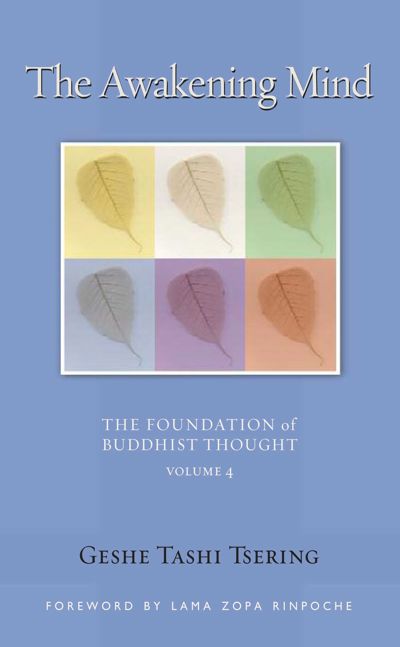
"With this series of books drawn from his highly successful courses, Geshe Tashi's insights can be enjoyed by a wide audience of both specialists and newcomers to the Buddhist tradition. His presentations, never divorced from the basic humanity and warmth of his personality, combine rigor and accessibility."
Description
Bodhichitta, often translated as "great compassion," is the gem at the heart of Buddhism. From this altruistic desire to serve others, all other Buddhist practices naturally flow, therefore, this state of mind is one Buddhists should understand and cultivate. In The Awakening Mind, Geshe Tashi Tsering leads us through the two main methods to develop bodhichitta that have been developed by the great Indian and Tibetan Buddhists over the centuries: the seven points of cause and effect, and equalizing and exchanging the self with others.
This is the fourth release from Geshe Tashi's Foundation of Buddhist Thought series, which individually and collectively represent an excellent introduction to Tibetan Buddhism. These unique and friendly books are based on the curriculum of a popular course of the same name, developed by Geshe Tashi himself.
Geshe Tashi's presentations combine rigor and comprehensiveness with lucidity and accessibility, never divorced from the basic humanity and warmth of his personality. In Geshe Tashi, we encounter the new generation of Tibetan monk-scholars teaching in the West who are following in the footsteps of such revered and groundbreaking teachers as Geshe Wangyal and Geshe Sopa.
Reviews
"These books may not be a single experience for you, but the beginning of a whole course of study. Whatever the case, they are thorough, easy to read and accessible."
"Provides a simple and systematic introduction to Buddhist philosophy and practice."
"Although coming from a traditional Gelugpa presentation of the Buddhist path, these books are written for a modern western audience, and therefore 'happiness' is presented as a principle goal, alongside the more traditional goal of enlightenment. The author's personal tone and his fluent language, combined with his obvious mastery of the material help to make the series a tremendously valuable resource for the study of basic Buddhist teachings from a Tibetan perspective."