“[Tutu’s] unofficial legacy will be his life and the story of how this tiny pastor with a huge laugh from South Africa became our global guardian.” - TIME
“For decades [Tutu] has been a moral titan—a voice of principle, an unrelenting champion of justice, and a dedicated peacemaker . . . an outspoken voice for freedom and justice in countries across the globe; a staunch defender of the rights of lesbian, gay, bisexual and transgender persons.” - President Barack Obama
“Desmond Tutu has walked the talk all his adult life. We can all be grateful that, together with his daughter Mpho, he has now shared his secrets for why he has so much hope and joy.” - Mary Robinson, former president of Ireland
“I doubt there is anyone on this Earth with a deeper sense of God’s presence and goodness than Archbishop Tutu.” - Thomas Cahill, author of How the Irish Saved Civilization and The Gifts of the Jews.
“I have the highest regard for my good and trusted friend Archbishop Desmond Tutu. I admire him for the wonderful, warm person he is and especially for the human principles he upholds.” - His Holiness the Dalai Lama
“I am lost for words to express my appreciation for this book … Desmond Tutu and his daughter show clearly that suffering, while always painful, need not destroy.” - Terry Waite, CBE
“What better guides and teachers on forgiveness than Bishop Tutu and his daughter who have lived faithfully through the hardest most demanding days of South Africa! This book meets an urgent need among us, and does so with wisdom, realism, and generosity.” - Walter Brueggemann, author of The Prophetic Imagination
“Includes instructions on how to forgive, as well as scientific and moral reasons to do so. No one is unforgiveable; it takes a moral icon such as Tutu to credibly assert this. . . . This book belongs on nightstands, shelves, and altars everywhere.” - Publishers Weekly (starred review)
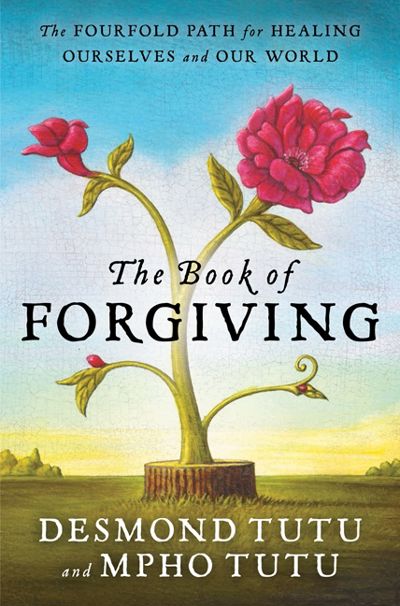
There are scads of books on forgiveness, but The Book of Forgiving is markedly different: A useful how-to handbook that helps us wade through a profoundly complex topic, the book is a tool for applying forgiveness in daily life. . . . One of the biggest strengths of the book is its holistic approach. . . . The Tutus create a safe space to enter into and face our rawest emotions. - Christian Century
“There is no one who embodies the virtue of forgiveness like Desmond Tutu. With this book, he and his daughter take forgiveness out of the realm of mystery and offer a handbook on forgiveness, revealing this most exacting and freeing of human capacities in all its complexity and transformative achievability.” - Krista Tippett, Host/Executive Producer of On Being
“A primer for not only finding the path for healing ourselves and the world, but for restoring balance in our biology, mind, and spirit.” - Deepak Chopra, author of What Are You Hungry For?
“Bishop Tutu and his daughter Mpho reveal groundbreaking insights as to how to acknowledge and resolve our lifelong burdens of anguish and pain towards a new paradigm of transformative healing.” - Annie Lennox
“I am lost for words to express my appreciation for this book. With considerable courage the authors recall the hurts they and others have suffered and how, in the face of dreadful wrongs, forgiveness has proved to be truly healing. Desmond Tutu and his daughter show clearly that suffering, whilst always painful, need not destroy.” - Terry Waite, CBE
“Desmond Tutu shows each of us how to transform our pain and sorrow into hope and confidence in the future. Whether you are the head of a country or the head of a household, you will cherish his words.” - Nelson Mandela, former president of South Africa and Nobel Peace Prize recipient
“Archbishop Desmond Tutu, like Dr. Martin Luther King, Jr. before him, has offered us a luminous vision of love and hope. With his great warmth and compassion, Archbishop Tutu offers a spiritual message that if heeded can change lives as well as history.” - Jimmy Carter
“Archbishop Tutu has the ability to see our shared humanity in each person he meets, and to get us to do the same.” - Bill Clinton
“One thing I have learned from [Tutu] . . . is that he has that constant and persistent faith that things can be better and we can do something about it. We should not find excuses not to act or not to speak out.” - Kofi Annan, former secretary-general of the United Nations and winner of the Nobel Peace Prize in 2001
“[Tutu] was not just an anti-apartheid worker. . . . He was somebody who had thought very deeply about spiritual values and had applied them to what he was doing. In some ways that reminded me of Gandhi.” - Daw Aung San Suu Kyi, winner of the Nobel Peace Prize
“There is no one in the modern world who embodies the virtue of forgiveness like Desmond Tutu. He has seen and lived the dark side of human cruelty, and this gives his capacity for forgiveness its integrity and its power. With this book, he and his daughter take forgiveness out of the realm of mystery. He offers a kind of handbook on forgiveness—revealing this most exacting and freeing of human capacities in all its complexity and transformative achievability.” - Krista Tippett, Host/Executive Producer of On Being