“Bruce Benson has provided us with an exciting book that probes and challenges our understanding of the nature of individual rights, the source of evolution of those rights, and the social instruments that might be used to enforce them. I am aware of no other source that approaches the central topic directly and with the insights provided by modern economics and public choice. He has made a solid contribution to our understanding of how the law is a natural consequence of the attempts of people to live and work with each other and can evolve naturally without the guiding hands of the state.”
Description
Defenders of the state’s monopoly on lawmaking and law enforcement typically assume that any alternative arrangement would favor the rich at the expense of the poor—or would lead to the collapse of social order and ignite a war. Questioning how well these beliefs hold up to scrutiny, this book offers a powerful rebuttal of the received view of the relationship between law and government.
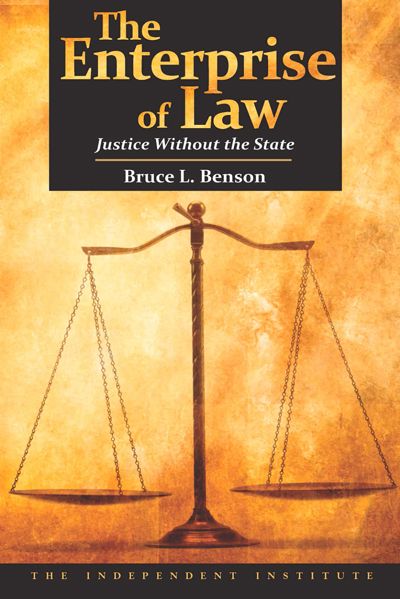
The provision of justice and security has long been linked in most people’s minds to the exclusive province of government monopolies. However, in this path-breaking book, Benson shows that a system of market-based institutions, rooted in the legal principle of personal accountability under a rule of law in all aspects of criminal justice, have and can deliver those services on their own, without the aid of taxation and a coercive state monopoly on the establishment and enforcement of law.
In The Enterprise of Law, Benson offers a powerful rebuttal of the received view of the relationship between law and government. The book brilliantly shows that non-state institutions have and do fight crime, resolve disputes, and render justice more effectively than the state because they have stronger incentives to do so.
The book offers a host of landmark findings, and here is just a sampling:
- The rapid recent growth of private-sector security and conflict resolution continues the effective legacy of private crime control and the common law.
- Protections for individual rights and private property are not the exclusive purview of government-run legal systems.
- Privatizing security and dispute-resolution services and contracting out to the private sector, can offer tangible benefits—namely better and more just services at lower costs.
Reviews
“The Enterprise of Law is an absolutely fascinating book...Benson breaks an incredible amount of new ground here, but his most important contribution is the clear, logical, historical, and readable presentation of the argument.”
“This is a valuable and interesting book...If Professor Benson is correct—as I believe he is—we would be better off if our present legal system was replaced by a system of customary law, privately evolved and privately enforced...Few skeptics will be persuaded of so radical a thesis in one reading, but the best of them should recognize that a real alternative is being proposed—and defended—by arguments that deserve to be taken seriously.”
“The Enterprise of Law is an important contribution to law and economics literature. He properly emphasizes the role of institutions in shaping incentive, and the role of incentives in shaping institutions.”