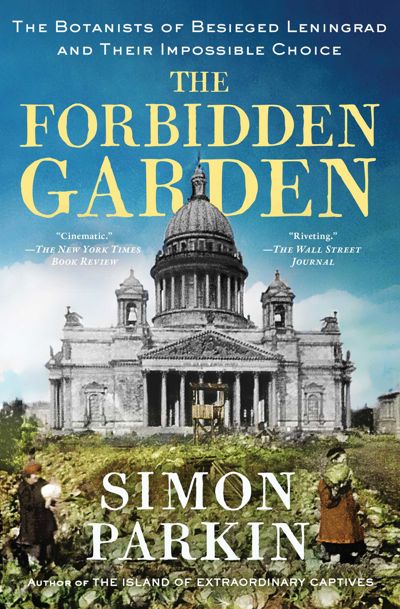
“Cinematic . . . ethically haunted . . . Simon Parkin examines the mad, heroic decision during the siege of Leningrad to guard biodiversity at the cost of human life. . . . the overarching question of what is right remains ever-present—a bright, painful line throughout." —The New York Times, Editors' Choice
"Do not miss this enthralling book . . . Parkin is that rare writer who is a prodigious researcher who can spin his findings into narrative gold. It is Parkin’s singular gift that the reader feels right beside him as he uncovers his tale." —Air Mail
"Riveting . . . Mr. Parkin tells his story with precision and panache . . . the stuff of cinema." —Wall Street Journal
“Parkin’s carefully researched and analytical narrative builds to an affecting conclusion . . . The Forbidden Garden tells a story almost a century old, but the tensions Parkin describes are anything but resolved. On a warming planet, as scientific truth is subject to political distortion and where autocracy is on the rise, scientists should be prepared to make many such 'impossible choices' as we attempt to protect the resources of the past in the face of an uncertain future.” —Science
"Parkin weaves together an incredible accounting about the sacrifices and resolution of the scientists overseeing the seed bank during the Siege of Leningrad. . . .This book is emotionally heavy but worth reading—it’ll surprise you to learn just how big a role these tiny seeds played in World War II and our agriculture today." —Scientific American
Description
Named a Best Book of the Year by The Guardian, Scientific American, and The Economist
The riveting, untold true story of the botanists at the world’s first seed bank who made “the mad, heroic decision during the siege of Leningrad to guard biodiversity at the cost of human life” (The New York Times, Editors’ Choice)—from the award-winning author of The Island of Extraordinary Captives.
In the summer of 1941, German troops surrounded the Russian city of Leningrad—now St. Petersburg—and began the longest blockade in recorded history, one that would ultimately claim the lives of nearly three-quarters of a million people. At the center of the besieged city stood a converted palace that housed the world’s largest collection of seeds—more than 250,000 samples hand-collected over two decades from all over the globe by world-famous explorer, geneticist, and dissident Nikolai Vavilov, who had recently been disappeared by the Soviet government. After attempts to evacuate the priceless collection failed and supplies dwindled amongst the three million starving citizens, the employees at the Plant Institute were left with a terrible choice. Should they save the collection? Or themselves?
These were not just any seeds. The botanists believed they could be bred into heartier, disease-resistant, and more productive varieties suited for harsh climates, thereby changing the future of food production and preventing famines like those that had plagued their countrymen before. But protecting the seeds was no idle business. The scientists rescued potato samples under enemy fire, extinguished incendiary bombs landing on the seed bank’s roof, and guarded the collection from scavengers, the bitter cold, and their own hunger. Then in the war’s eleventh hour, Nazi plunderers presented a new threat to the collection…
Drawing from previously unseen sources, award-winning journalist Simon Parkin tells the incredible true story of “an extraordinary project and the bravery of the ordinary individuals who kept it going” (The Daily Telegraph, London) in the name of science.
Reviews
"A richly researched and meticulously observed account of a little-explored corner of 20th-century history." —The Guardian
"A compelling account. . . . I’ve read histories of the siege before, but few with such disarming immediacy. The Forbidden Garden has a galloping pace. . .. . a remarkable work of literary exhumation. The first full account of the Plant Institute in any language, it’s a fitting testimony to an extraordinary project and the bravery of the ordinary individuals who kept it going—the men and women who were prepared to sacrifice all for the sake of a spud." —Daily Telegraph
"Vivid . . . Engaging." —Times Literary Supplement
"Thank goodness for Simon Parkin who has unearthed the remarkable story of a clutch of scientists holed up in a converted palace in the city who were running effectively the world's first seed bank . . . an enthralling book." —New European
"[A] rich . . . gripping, sensitive account." —Spectator
"Extraordinary . . . a history book as gripping as a thriller . . . striking narrative gold, [Parkin] sets out this remarkable story in admirable detail, drawing upon fresh research sources . . . absorbing throughout." —The i Paper
"Simon Parkin vividly relates the tragic yet inspiring story of Vavilov and his team’s dedication to the [seedbank]. . . . Using the diaries and letters of the botanists, as well as later-recorded oral histories, Parkin paints a suspense-filled record of this harrowing time in history." —BookPage (starred review)
“A beautifully-written account of one of the most extraordinary and little-known episodes of the Second World War—a scientific feat and act of collective self-sacrifice the consequences of which continue to be felt today.” —Adam Higginbotham, New York Times bestselling author of Midnight in Chernobyl and Challenger