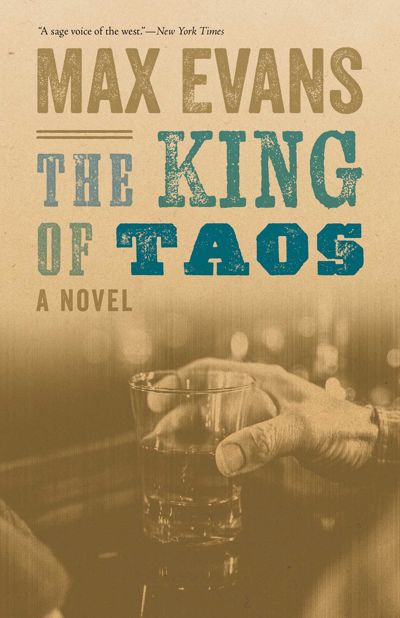
"In my opinion, Evans was an author akin to James Joyce, John Steinbeck, and J. P. S. Brown. . . . I believe anyone who reads The King of Taos and savors Evans's writing will not only be inspired, but have their own personal spiritual awakening through Max's prose and the fictional-life experiences of his characters."
Description
Winner of the 2021 Western Heritage Award for Outstanding Western Novel
Max Evans' wit and humanity sparkle in the guise of a humorous cast of characters set in the underworld of Taos, New Mexico, in the 1950s.
The underground world of con men, winos, prostitutes, laborers, and artists has been an abundant source of material for great writers from Dickens to Bukowski. The underground world of Taos, New Mexico, is no different. In the late 1950s this mountain town was higher, brighter, poorer, and farther removed than London, Paris, or Los Angeles, but it was every bit as rich for the explorations of a young writer. Max Evans, the beloved New Mexican writer of such enduring classics of Western fiction as The Rounders and The Hi-Lo Country, returns to form with The King of Taos. Set in the late 1950s, the novel tells the stories of sharp-witted Zacharias Chacon, aspiring artist Shaw Spencer, and a circle of characters who drink, fight, love, argue, and—mostly—talk. Readers will enjoy this witty and moving evocation of unforgettable characters as they look for work, love, comfort, dignity, and bottomless oblivion.
Reviews
“The book is about the camaraderie, the joy of life, the musings, and the misadventures and dreams of Zacharias and his Tokay-loving friends.”
“Max Evans is a legendary New Mexico author. . . . He moved to Taos with visions of becoming rich and famous. Now, sixty years later, Max would say he is neither, but his newest book is certainly rich.”
"Evans may have been born in Texas, but New Mexico—the setting of many of his twenty-five novels—captured his heart. His latest, written at ninety-five years old, is no exception. A series of sharp vignettes describe the meandering misfortunes of the drunken ne'er-do-wells who populate post-World War II Taos."