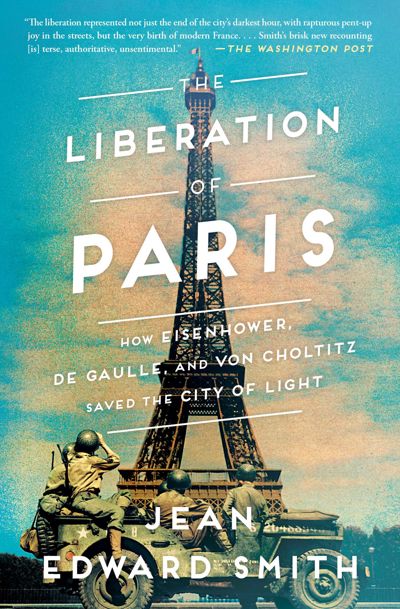
Prize-winning and bestselling historian Jean Edward Smith tells the “rousing” (Jay Winik, author of 1944) story of the liberation of Paris during World War II—a triumph achieved only through the remarkable efforts of Americans, French, and Germans, racing to save the city from destruction.
Following their breakout from Normandy in late June 1944, the Allies swept across northern France in pursuit of the German army. The Allies intended to bypass Paris and cross the Rhine into Germany, ending the war before winter set in. But as they advanced, local forces in Paris began their own liberation, defying the occupying German troops.
Charles de Gaulle, the leading figure of the Free French government, urged General Dwight Eisenhower to divert forces to liberate Paris. Eisenhower’s advisers recommended otherwise, but Ike wanted to help position de Gaulle to lead France after the war. And both men were concerned about partisan conflict in Paris that could leave the communists in control of the city and the national government. Neither man knew that the German commandant, Dietrich von Choltitz, convinced that the war was lost, schemed to surrender the city to the Allies intact, defying Hitler’s orders to leave it a burning ruin.
In The Liberation of Paris, Jean Edward Smith puts “one of the most moving moments in the history of the Second World War” (Michael Korda) in context, showing how the decision to free the city came at a heavy price: it slowed the Allied momentum and allowed the Germans to regroup. After the war German generals argued that Eisenhower’s decision to enter Paris prolonged the war for another six months. Was Paris worth this price? Smith answers this question in a “brisk new recounting” that is “terse, authoritative, [and] unsentimental” (The Washington Post).