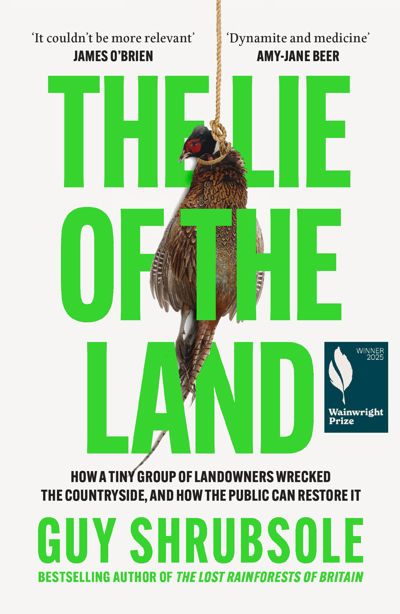
The Lie of the Land

Who Really Cares for the Countryside?

Description

'Brave and brilliant’ GEORGE MONBIOT

'Urgent and essential … should be required reading' CAROLINE LUCAS

For centuries we’ve been sold a lie: that you need to own the land to care for it.

Just 1% of the population own half of England, and this tiny landowning elite like to present themselves as the rightful custodians of the countryside. They’re even paid billions of pounds of public money to be good stewards. But what happens when they just don’t care?

A small number of landowners have laid waste to some of our most treasured landscapes, leaving our forests bare, our rivers polluted, our moorlands burned, and our fenlands drained. Here Guy Shrubsole journeys all over Britain to expose the damage done to our land, and meet the communities fighting back: the river guardians, small farmers and trespassing activists restoring our lost wildlife. Full of rage and hope, this is a bold vision for our nation’s wild places, and how we can treat them with the awe and attention they deserve.

It’s time to demand better for nature. We can start by replacing the lie of the land with a profound truth: that any of us can care for the countryside, regardless of whether you own it.

'The unjust impositions of historic land ownership blight all our lives – here Guy shows why’ Chris Packham

'Both dynamite and medicine' Amy-Jane Beer

About the author(s)

Guy Shrubsole is an environmental campaigner and writer. He is the author of Who Owns England?, an instant Sunday Times bestseller, and The Lost Rainforests of Britain, which won the Wainwright Prize for Writing on Conservation. For the past decade Guy has campaigned on the climate and nature crises, working for organisations ranging from Friends of the Earth and the Right to Roam campaign, to Defra. He lives in Devon.

Reviews

'A fascinating exposé' The i

'Compellinga timely and important book’ Geographical Magazine

'Exhilarating, insightful and bristling with rightful indignation' Lee Schofield

'The unjust impositions of historic land ownership blight all our lives – here Guy shows why’ Chris Packham

'What a book! Vitally important, and superbly written' Aaron Bastani

‘Shrubsole has the belly fire of a campaigner but the precision of an historian’ Roger Mortlock, Chief Executive of CPRE

‘A heartfelt, historically resonant call to reject the myth that private landownership delivers good stewardship of nature' Corinne Fowler

A smart, peaceful and practical plan for how we can turn this land into our land’ Patrick Barkham

‘If you care about our environment, read this book’ Sir John Lawton CBE FRS

‘This book beautifully subverts the central orthodoxy of England, that owning land is the only way to care for it’ Nick Hayes

'This is Guy Shrubsole’s best book yet' Mark Avery

‘Guy Shrubsole asserts the right of the majority to engage in what happens to land. As England struggles with its post-Brexit identity, the lie of the land matters deeply’ Tim Lang

‘At once shocking and comforting, scathing and uplifting. A book on this subject shouldn't be so readable. A triumph’ Sophie Pavelle

‘Who really cares for the countryside? Guy does. His articulate fervour, seasoned with humour, shouts from every page. He throws down a timely gauntlet to centuries of tradition’ Tom Heap

Extraordinary. An affirmation of another kind of rural life that exists within this lie, and all the possibilities that are open to us if we defy it’ Nicola Chester

A rousing call to action that proposes practical interventions for how management of the countryside could – and should – be improved for the benefit of both people and environment’ Claire Ratinon

'Radical and urgent, measured and considered … an essential place to start’ Dr Rose O’Neill, Chief Executive, Campaign for National Parks

More by Guy Shrubsole

More Ecosystems & Habitats

More Nature

More All Other Nonfiction

More Environmental Conservation & Protection

More Environmental Policy

More Public Policy

More Political Science

More Agriculture & Food

More Social Science

More Rural

More Sociology