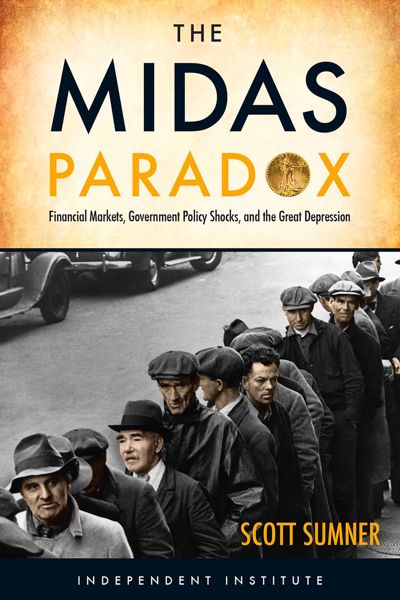
Economic historians have made great progress in unraveling the causes of the Great Depression, but not until Scott Sumner came along has anyone explained the multitude of twists and turns the economy took.
In The Midas Paradox: Financial Markets, Government Policy Shocks, and the Great Depression, Sumner offers his magnum opus—the ?rst book to comprehensively explain both monetary and non-monetary causes of that cataclysm.
Drawing on ?nancial market data and contemporaneous news stories, Sumner shows that the Great Depression is ultimately a story of incredibly bad policymaking—by central bankers, legislators, and two presidents—especially mistakes related to monetary policy and wage rates. He also shows that macroeconomic thought has long been captive to a false narrative, which continues to misguide policymakers in their quixotic quest to promote robust and sustainable economic growth.
The Midas Paradox is a landmark treatise that solves mysteries that have long perplexed economic historians and corrects misconceptions about the true causes, consequences, and cures of macroeconomic instability. Like Milton Friedman and Anna J. Schwartz’s A Monetary History of the United States, 1867–1960, it is one of those rare books destined to shape future research and debate on the subject.