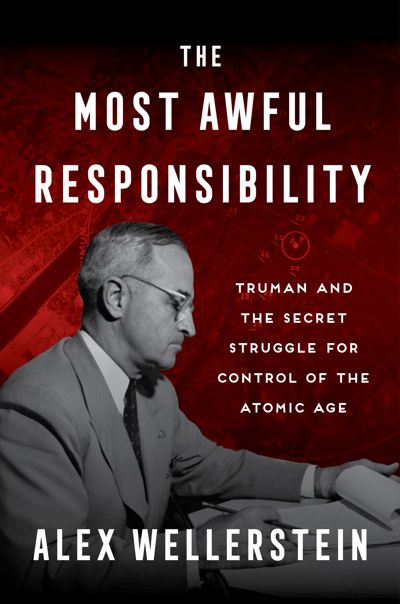
The Most Awful Responsibility

Truman and the Secret Struggle for Control of the Atomic Age

Description

"I thought I knew the story but learned much that I didn’t know. Outstanding!"— Richard Rhodes

“This is historical research at its best.” — Dan Carlin

President Truman’s choice to drop the atomic bomb is the most debated decision in the 20th Century. But what if Truman’s actual decision wasn’t what everyone thinks it was?

The conventional narrative is that American leaders had a choice: Invade Japan, which would have cost millions of Allied and Japanese lives, or instead, use the atom bomb in the hope of convincing Japan to surrender. Truman, the story goes, carefully weighed the pros and cons before deciding that the atomic bomb would be used against Japanese cities, as the lesser of two evils.

But nuclear historian Alex Wellerstein argues that is not what happened.

Not only did Truman not take part in the decision to use the bomb, but the one major decision that he did make was a very different one — one that he himself did not fully understand until after the atomic bomb was used. The weight of that decision, and that misunderstanding, became the major reason that atomic bombs have not been used again since World War II.

Based on a close reading of the historical record, The Most Awful Responsibility shows that, despite his reputation as an ardent defender of the atomic bomb, Truman:

  • Wanted to avoid the “murder” and “slaughter” of innocent civilians
  • Believed that the atomic bomb should never be used again
  • Hoped that nuclear weapons would be outlawed in his lifetime

Wellerstein makes a startling case that Truman was possibly the most anti-nuclear American president of the twentieth century, but his ambitions were strongly constrained by the domestic and international politics of the postwar world and the early Cold War. This book is a must-read for all who want to truly understand not only why the bomb was dropped on Japan but also why it has not been used since.

About the author(s)

Alex Wellerstein is an Associate Professor in the Science and Technology Studies program at the Stevens Institute of Technology. He is the author of Restricted Data: The History of Nuclear Secrecy in the United States, and he has written for The New Yorker, Atlantic, Harper’s Magazine, and many other venues. He is perhaps best known as the creator of the NUKEMAP, the world’s most popular online nuclear weapons effects simulator. He is also the author of the Doomsday Machines blog, and he has taught at Harvard, MIT, and Georgetown University.

Reviews

"“Alex Wellerstein clears away the dead timber in this gripping investigation of President Truman’s relationship with the atomic bomb. I thought I knew the story but learned much that I didn’t know. Outstanding!"
Richard Rhodes, Pulitzer Prize Laureate for The Making of the Atomic Bomb

“What if so much of what we always thought we knew about Truman’s use of the bombs wasn’t true? If Alex Wellerstein is right, you will never be able to have another discussion about the dropping of the atomic bombs in 1945 without taking into account the points made in this book. This is historical research at its best. It challenges long-held beliefs on the decision to use atomic weapons on Hiroshima and Nagasaki while highlighting why nuclear weapons evolved as they did after 1945.” — Dan Carlin, host of the Hardcore History podcast and author of the New York Times bestseller The End Is Always Near

“Harry Truman presided over the only wartime use of nuclear weapons, and he also more forcefully checked military encroachments on this weapon than any subsequent commander-in-chief — all while the world descended into a rather hot Cold War. In this page-turning account, Alex Wellerstein brings us closer than we have ever been to understanding the paradoxes of how, through numerous actions and inactions, large and small, one quite ordinary man — perhaps because he was so ordinary — shaped the nuclear age.” — Michael D. Gordin, Professor of Modern and Contemporary History at Princeton University, author of Five Days in August: How World War II Became a Nuclear War

"A nuanced portrait of a president who shaped the modern nuclear age." — Kirkus Reviews

"Many people think that the U.S. decision to use atomic bombs against Japan in 1945 was made by a pro-nuclear President Truman, hoping to persuade the Japanese to surrender to the Allies and end six years of war. But Wellerstein argues that this was not the case. . . . This must-read book takes readers on a journey through the use of atomic weapons as it relates to the geopolitical landscape and how the Hiroshima and Nagasaki bombing shaped current views on atomic weapons and deterrence." — Thomas O’Brien, Library Journal (Starred Review)

More by Alex Wellerstein

More 20th Century

More United States

More History

More Weapons

More Military

More Presidents & Heads of State

More Biography & Autobiography