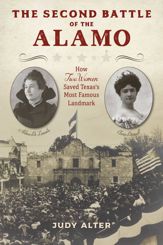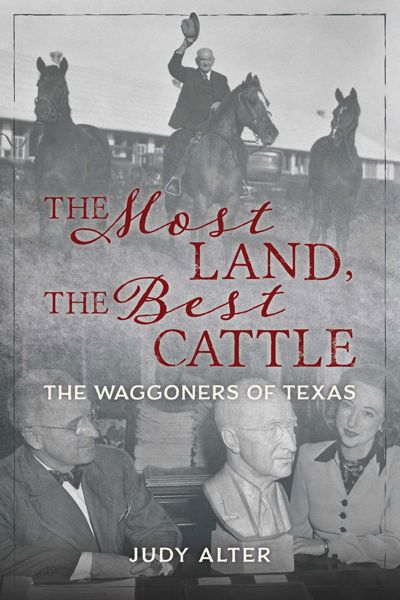
The majesty and intrigue of a ranch is of course invested in the land and livestock. But the true soul of a ranching property rests with the humans involved, both staff and owners. Judy Alter has done a magnificent job of explaining and describing the amazing family of the world famous Waggoner Ranch, 'all under one fence'.
Description
In the 19th century, Daniel Waggoner and his son, W.T. (Tom), put together an empire in North Texas that became the largest ranch under one fence in the nation. The 520,000-plus acres or 800 square miles covers six counties and sits on a large oil field in the Red River Valley of North Texas. Over the years, the estate also owned five banks, three cottonseed oil mills, and a coal company.
While the Waggoner men built the empire, their wives and daughters enjoyed the fruits of their labor. This dynasty’s love of the land was rivaled only by their love of money and celebrity, and the different family factions eventually clashed.
Although Dan seems to have led a fairly low-profile life, W. T. moved to Fort Worth, became a bank director, built two office buildings, ran his cattle on the Big Pasture in Indian Territory (Oklahoma), hosted Teddy Roosevelt at a wolf hunt in the Big Pasture, and sent Quanah Parker to Washington, D.C., for Roosevelt’s inauguration. W. T. had two sons, Guy and E. Paul, and a daughter named Electra, the light of his life. W. T. built a mansion in Fort Worth for her—today the house, the last surviving cattle baron mansion on Fort Worth’s Silk Stocking Row, is open to the public for tours and events. Electra, an international celebrity and extravagant shopper (she once spent $10,000 in one day at Neiman Marcus), died at the age of forty-three.
Guy had nine wives; his brother E. Paul, partier and horse breeder, was married to the same woman for fifty years and had one daughter, Electra II. Electra II was a both a celebrity and a talented sculptor, best known for a heroic-size statue of Will Rogers on his horse, Soapsuds, as well as busts of two presidents and various movie stars. After marriage to an executive she settled in a mansion at the ranch and raised two daughters.
This colorful history of one of Texas’s most influential ranching families demonstrates that it took strength and determination to survive in the ranching world…and the society it spawned.
Reviews
Texas's natural resources and environment have been both a blessing and a curse. When rains fail to come and the land turns hostile to anything that tries to live on it, the place can be a scourge. When conditions are ideal or when treasures that lie beneath the surface bring bounty, it can be a paradise. Such phenomena frame the story of a number of Texas ranches and legacy ranch families—years of struggling against environmental and other obstacles to establish and maintain an operation that is saved when the land yields the "black gold" beneath the soil of that toil. The Waggoners of Texas fit just such a mold, and Judy Alter's fine monograph, The Most Land, the Best Cattle: The Waggoners of Texas, is an apt vehicle to relate the family's narrative.
Alter, an award-winning author and former director of TCU Press, is not the first writer to tackle the story of the Waggoners, but her unique style and fine writing make her work an instant, positive addition to the Waggoner canon. Alter used the Waggoners as the model for her excellent historical fiction, So Far from Paradise, which first appeared in the Fort Worth Star Telegram as part of a serial for the Texas Sesquicentennial. In that work, Alter told her story from the women's point of view, but in her new non-fiction adaptation she approaches the Waggoners from the perspective of both men and women. Alter's current treatment is readable, relatable, and an excellent form of popular history.
Alter's factual presentation and material are solid. She approaches her subjects from a biographical perspective, as each chapter is a sketch of a member of the Waggoner family's life. Part 1 is "The Waggoner Men," in which she recounts the lives of Daniel Waggoner, the founder of the Waggoner Ranch, and W. T. Waggoner, the most notable member of the family—outside of perhaps his daughter, the flamboyant Electra—and the one who benefitted when drillers discovered vast reserves of petroleum beneath the ranch. She ends part 1 with a short treatment of the "Next Generation of Waggoner Men," mostly about W. T.'s sons, Guy and E. Paul, and paragraphs on Tom and Buster, the sons of Electra. Alter writes each chapter in an accessible manner, a chronological narrative that not only highlights the life of each of her subjects, but also allows the reader to understand and capture the personality of each Waggoner.
Part 2, "The Waggoner Women," is the highlight of the work, understandably so given Alter's previous work in So Far from Paradise. It certainly does not hurt that the Waggoner women—particularly both Electras—were fascinating, outsized characters who made quite the impression during their lives. Alter begins with Ella Halswell Waggoner, W. T.'s wife, then documents the lives of Ella's daughter, Electra, and her granddaughter (daughter of E. Paul), Electra Waggoner Biggs. Alter's accounts of the Waggoner women demonstrate, even more than her lives of the Waggoner men, how the course of generations transforms the personality and character of a family. While Ella never left behind the simple life she had lived before and, for a time, after she married W. T., both Electras lived flamboyant and controversial lives that perennially captured the attention not just of Texas but of national media as well.
I highly recommend Alter's work as a refreshing and enjoyable read and a lesson that good history does not have to be obtuse or inaccessible. Telling a story is the best course, one that The Most Land, the Best Cattle does well.