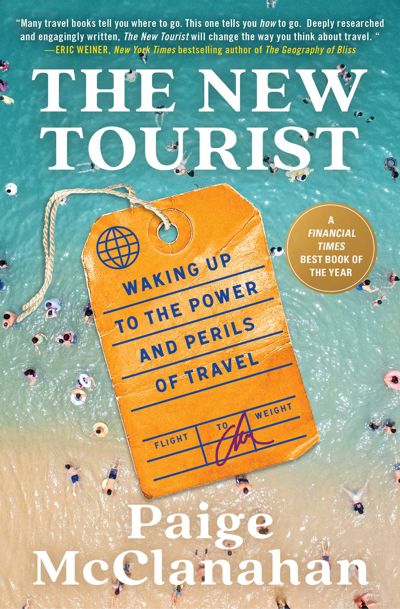
Selected by National Geographic as a “Best Book to Inspire Your Next Trip”
A Financial Times Best Book of the Year
A Smithsonian pick as one of the Year’s “Ten Best Books on Travel”
Author selected by Outside as a “2024 Outsider of the Year”
“Conversation stirring…Deeply researched, with dispatches from Barcelona to Iceland…digs into the negative and positive impacts of tourism with nuance and care.”
—National Geographic
“[A] fun and breezy way of looking at different aspects of modern travel.”
—Alex Schwartz, The New Yorker’s “Critics at Large”
Description
“A genuinely helpful framework for thinking about our own voyages” (The Atlantic), The New Tourist explores how tourism has shaped the world, for better and for worse, and offers essential reading for anyone looking for a deeper understanding of the implications of their wanderlust.
Through deep and insightful dispatches from tourist spots around the globe—from Hawaii to Saudi Arabia, Amsterdam to Angkor Wat—The New Tourist shines a light on an industry that accounts for one in ten jobs worldwide and generates nearly ten percent of global GDP. How did a once-niche activity become the world’s most important means of contact across cultures? When does tourism destroy the soul of a city, and when does it offer a place a new lease on life? Is “last chance tourism” prompting a powerful change in perspective—or driving places we love further into the ground?
“Engaging and thoughtful” (Kirkus Reviews) and filled with page-turning revelations, The New Tourist spotlights painful truths but also delivers a message of hope: that the right kind of tourism—and the right kind of tourist—can be a powerful force for good.
Reviews
“[A] nuanced approach to tourism is baked into the premise of The New Tourist… yet McClanahan remains unwavering in her belief that tourism can be a net good.”
—Condé Nast Traveler
“Proposes a genuinely helpful framework for thinking about our own voyages…Traveling, McClanahan suggests, helps people more keenly discern the difference between a state’s positions and the culture of its people by seeing it with their own eyes.”
—The Atlantic
“A timely look at the double-edged phenomenon of leisure travel.”
—Financial Times