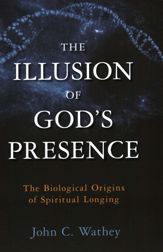
“The Phantom God integrates novel ideas in evolution, cognitive science, neuroscience, plus psychedelics and drug addiction. Wathey's bold hypothesis — that the illusion of God’s presence comes from an innate neural model — lays down a scientific challenge, but won't convince believers. No one who seeks the foundations of religion can ignore The Phantom God.” — Robert Lawrence Kuhn, creator and host of Closer To Truth
Description
Does neuroscience have anything to say about religious belief or the existence of God? Some have tried to answer this question, but, in doing so, most have strayed from the scientific method.
In The Phantom God, computational biologist and neuroscientist John C. Wathey, Ph.D., tackles this problem head-on, exploring religious feelings not as the direct perception by the brain of some supernatural realm, nor as the pathological misfiring of neurons, but as a natural consequence of how our brains are wired.
Unlike other neurobiological studies of religion and spirituality, The Phantom God treats mysticism not as something uniquely human and possibly supernatural in origin, but as a completely natural phenomenon that has behavioral and evolutionary roots that can be traced far back into our vertebrate ancestry. Grounded in evolutionary and behavioral biology, this highly original and compelling book takes the reader on a journey through the neural circuitry of crying, innate knowledge, reinforcement learning, emotional bonding, embodiment, interpersonal perception, and the ineffable feeling of certainty that characterizes faith.
Wathey argues that the feeling of God’s presence is spawned by innate neural circuitry, similar to the mechanism that compels an infant to cry out for its mother. In an adult, this circuitry can be activated under conditions that mimic the extreme desperation and helplessness of infancy, generating the compelling illusion of the presence of a loving, powerful, and all-knowing savior. When seen from this perspective, the illusion also appears remarkably like one that has long been familiar to neurologists: the phantom limb of the amputee, spawned by the expectation of the patient’s brain that the missing limb should still be there.
Including a primer on the basic concepts and terminology of neuroscience, The Phantom God details the neural mechanisms behind the illusions and emotions of spiritual experience.
,
Reviews
"Now I understand what was happening in my brain when I experienced the vivid parental 'presence of God' that gave me goosebumps and brought me to tears. In The Phantom God, John Wathey supports his brilliant hypothesis with facts and enjoyably clear explanation. This is science writing at its best."
– Dan Barker, co-president of Freedom from Religion Foundation, and author of Godless and Free Will Explained, among others
“This deeply engaging and challenging book relates some of the most puzzling aspects of religion to a broad range of empirical research on the brain — including case studies of brain pathology, hallucinations, and lateralization — and reveals surprising evidence of shared underlying neural mechanisms. Concluding that an innate neural model can explain many religious phenomena, Wathey offers thoughtful research suggestions for further testing his ideas. In sum, a masterful work that deserves close attention.”
—David M. Wulff, Professor of Psychology Emeritus, Wheaton College (MA), and author of Psychology of Religion: Classic and Contemporary
“John Wathey has made landmark contributions to the anatomy of religious belief. The Phantom God gives us the fundamental hows of religion’s tenacious hold on human minds, the neuroscience buried deep in our neonatal and early infant attachment system. Read this landmark book, and treasure it.”— J. Anderson Thomson, Jr., M.D., Psychiatrist, University of Virginia, author of Why We Believe In God(s): A Concise Guide to the Science of Faith.