“This book is full of surprises and encouragement to be who we really are, building clear bridges on perennial religious questions and excavating a trustworthy path from us to Shakyamuni Buddha. What a deep joy to receive the wisdom and great compassion of this wholehearted book.”
Description
Musings and autobiographically informed commentary on the human condition through the lens of the Kannon-gyo—chapter 25 of the Lotus Sutra—connecting Zen and Pure Land Buddhism through the practice of venerating and chanting the names of buddhas and bodhisattvas.
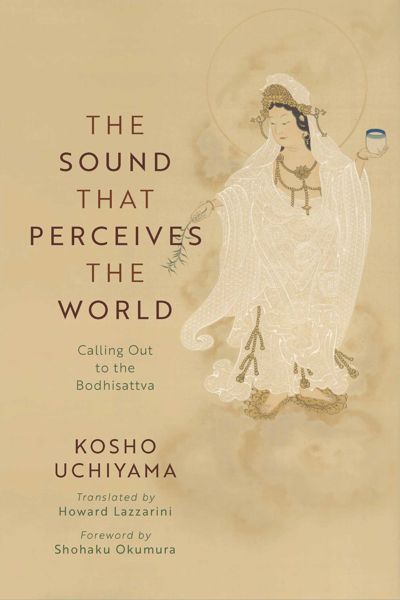
The Kannon-gyo is chapter 25 of the Lotus Sutra, and its focus is the bodhisattva of compassion, Avalokiteshvara, known in China as Guanyin, and in Japan as Kannon or Kanzeon. The text describes the many ways in which calling out the bodhisattva’s name—Namu Kanzeon Bosatsu—can relieve suffering.
Most schools of Zen Buddhism, and especially the Soto school, eschew such practices as chanting the names of buddhas and bodhisattvas, along with venerating such figures.
The eminent Soto Zen master Kosho Uchiyama Roshi, however, while doing hard physical labor early in his career, could not practice zazen—that is, formal sitting meditation. He came to appreciate the Kannon-gyo and the practices related to it. In particular, he took to reciting Kannon’s name, as recommended in the text of the Kannon-gyo.
Later in life, Uchiyama Roshi suffered from illness that again prevented him from practicing formal Zen, so he returned to the Kannon-gyo and the practice of chanting. He went so far as to assert that chanting Kannon’s name is completely equivalent to zazen, that the two practices are simply two sides of the same coin—a revolutionary idea seemingly at odds with Zen.
Chanting practice is especially accessible, as it can be done while working, traveling, or suffering from illness, and other activities that would ordinarily get in the way of formal Zen practice.
With these practices, the Kannon-gyo, and Kannon herself as a backdrop, Uchiyama Roshi muses about the purposes of religion, the goals of religious practice, and the meaning of enlightenment—and their relation to suffering itself.
Reviews
“Uchiyama Roshi’s fierce voice cuts through complacency. His unique integration of Zen, devotional Buddhist practice, Christianity, and existentialism offers a bracingly fresh view of the cry for help that forms much religious prayer.”
“This book is nothing less than a balm to soothe; medicine to relieve our symptoms; a gentle voice to encourage us to persist, delivered through this sensitive, accessible, and masterful translation by Howard Lazzarini. In the midst of this great fire we are living in, here is a voice to lead us to kindness and sanity, to the compassion and forgiveness that makes living possible.”
“The Sound That Perceives the World, an intimately personal account by a renowned Japanese Zen master, is an invitation for us to open the eyes and ears of our heart to the boundless compassion pervading the universe, and to come to realize that Kanzeon is no other than you and me, each and every one of us."