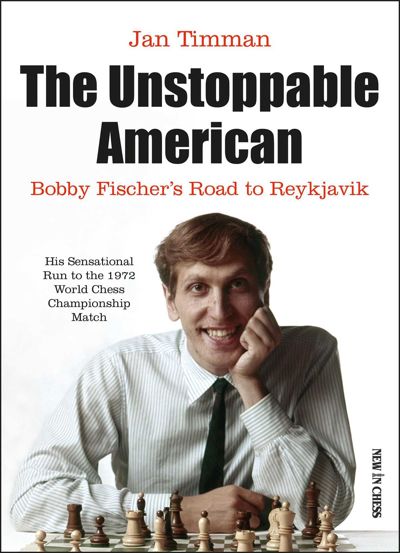
“Covers the two years leading up to the Reykjavik match, 1970 and 1971, when Fischer was winning tournaments by huge margins and had his unprecedented, and to this day unmatched, run of wins in the Interzonal and Candidates matches. This was his golden period. Timman has plucked relevant details from other biographies to tell the story of Fischer’s life at that time and added reminiscences from those that knew and played Fischer, Robert Hübner and Miguel Quinteros, for example, whom Timman knows well. That is a bonus. But Timman’s annotations of 63 games from that period are the real highlight of the book: he compares previous opinions, and then gives his own insight, backed up by computer analysis, so that we get closer to a more objective view of Fischer’s play. The games are well explained, and variations only given selectively at important moments. You can go through the book without a chess set and get the story and understand what was going on in those games. I warmly recommend the book. I think it is excellent.”

Description
Initially things looked gloomy for Bobby Fischer. Because he had refused to participate in the 1969 US Championship, he had missed his chance to qualify for the 1970 Interzonal Tournament in Palma de Mallorca. Only when another American, Pal Benko, withdrew in his favour, and after the officials were willing to bend the rules, could Bobby enter the contest. And begin his phenomenal run that would end with the Match of the Century in Reykjavik against World Champion Boris Spassky.
Fischer started out by sweeping the field at the 23-round Palma Interzonal to qualify for the next stage of the cycle. In the Candidates Matches he first faced Mark Taimanov, in Vancouver. Fischer trounced the Soviet ace, effectively ending Taimanov’s career. Then, a few months later in Denver, he was up against Bent Larsen, the Great Dane. Fischer annihilated him, too. The surreal score in those two matches, twice 6-0, flabbergasted chess fans all over the world.

In the ensuing Candidates Final in Buenos Aires, Fischer also made short shrift of former World Champion Tigran Petrosian, beating the hyper-solid ‘Armenian Tiger’ 6½-2½. Altogether, Fischer had scored an incredible 36 points from 43 games against many of the world’s best players, including a streak of 19 consecutive wins. Bobby Fischer had become not just a national hero in the US, but a household name with pop-star status all over the world.
Jan Timman chronicles the full story of Fischer’s sensational run and takes a fresh look at the games. The annotations are in the author’s trademark lucid style, that happy mix of colourful background information and sharp, crystal-clear explanations.
Genres
Reviews
“What strikes you most as Timman takes you through each tournament game by game is the stability of Fischer’s play: some¬times extremely powerful, some¬times less inspired but never less than completely focused whatever the stage of the game. That’s an astonishing achievement over such a period of time against such strong opposition. Timman’s annotations are really good: generally, not too variation heavy, full of human insight and strong in identifying the turning points of games. Looking at Fischer’s games with the benefit of an engine, you see that he did – by engine stand¬ards – make numerous small inac¬curacies while converting his advan¬tages but you also understand what a fantastic feel Fischer had for the crucial moments in a game. You don’t see many examples in his play of passivity or failing to take action when it was required. Another really good book – we really are lucky to have such fine players and legends as Jan [Timman] writing books like this!”
“Fischer’s key games in the run-up are given splendid attention. As Daniel King has pointed out, Timman manages just the right balance of words and variations. The result can be wonderfully informative and instructional, as can his insights into individual playing styles. Key strategic themes are always identified and, in the process, Timman debunks quite a few myths. Timman’s personal voice is always engaging and worth listening to and, in many ways, he is taking over Genna Sosonko’s mantle as the best chess writer around, with, of course, the bonus of actual games
“In his comments [Timman] doesn't overwhelm the reader with endless variations, but instead limits himself to a selection of the important moments and variations in order to highlight the critical points and to tell the story of the respective game. This makes the analyses very comprehensible and a pleasure to follow. Timman's comments allow the reader to enjoy and to appreciate Fischer's fantastic chess but also reveal that the American needed some luck to achieve his incredible results. Timman's easy and confident way of writing is also remarkable. He has drawn from various sources about Fischer,'s life from 1970 to 1971 but as with the analyses of the games, Timman again carefully selected the wealth of material, which he occasionally supplements with anecdotes from his own life, his own views and the opinions of other players such as Robert Hübner or Vlastimil Hort, who knew and played against Fischer. Timman's narrative skills and his deep insight into professional chess allow him to tell the well-known story of Fischer's path to the World Championship in a way that is exciting and entertaining but also restrained and neutral. This makes both parts of The Unstoppable American, Timman's analyses and the book's narrative passages, a delight to read, and even ardent Fischer fans who know almost everything ever published about their controversial hero should enjoy the book and learn new things about ‘Bobby’.”