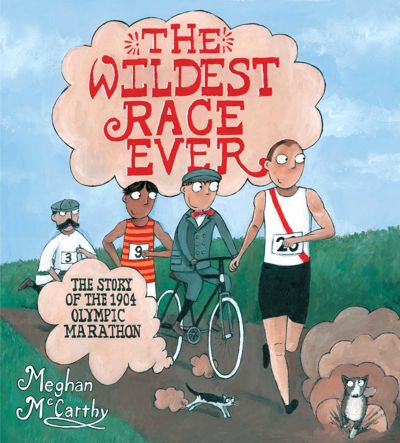
With her signature narrative zeal and goggle-eyed characters,McCarthy takes readers to the first Olympic marathon in America, held duringthe St. Louis World’s Fair. The vehicles trailing the pack kicked up dust thatchoked and blinded the runners. Cuban Felix Carvajal couldn’t resist stoppingfor fresh fruit or practicing his English with cheering onlookers. SouthAfrican Len Tau “was chased a mile off course by an angry dog.” American FredLorz, first over the finish line, probably rode most of the course in a car.And Thomas Hicks, another American and the eventual official winner, was givena concoction of egg white and strychnine en route. Readers who have grown upwith highly orchestrated sports events on TV may be surprised to learn just howslapdash, hazardous, and idiosyncratic early competition could be. But thestory requires a marathoner’s concentration to keep track of its 10 maincharacters, and the subject matter doesn’t offer McCarthy the kind of meatyambiguity that have made her previous works like Earmuffs for Everyone!so fun and compelling.
Description
From Megan McCarthy the award-winning author of Pop! and Earmuffs for Everyone comes the quirky, fascinating, and inspiring story of perseverance and the importance of sportsmanship set at the 1904 St. Louis Olympic Marathon.
It was 1904 and St. Louis was proud to host the World’s Fair and America’s First Olympics. Hundreds of thousands of people came by car, by train, by boat. Part of the Olympics was a wild, wacky marathon. Forty-two racers registered, thirty-two showed up, and of the three racers vying for the finish line: on drove part way, one was helped by his trainers over the line, and one was a postman who travelled from Cuba and ran in street clothes that he cut off to look like shorts. How they ran and who won is a story of twists and turns that only wouldn’t be believed if it weren’t true! And it is! Find out who won in this wacky and well-researched picture book all about the historic Olympic Marathon of 1904.
Reviews
McCarthy presents a look at the first Olympic marathon held in America. This 24.85-mile race took place in 1904 and was part of the St. Louis World’s Fair. The 32 runners who endured the 90-degree heat were offered water only at mile six and mile 12. The track was dirt, and cars and bicycles churned up so much dust that the athletes could hardly breathe.The illustrations are rendered in colorful acrylics, and McCarthy portrays her cartoonlike characters with bug eyes with tiny black pinpricks for pupils. The tone is lighthearted and humorous; for instance, McCarthy describes the antics of runner Felix Carvajal, a mailman from Cuba, who wore trousers and work shoes, pausing to chat with passersby to practice his English and resting in an apple orchard when he got hungry. End papers are comprised of photographs of World’s Fair postcards of the time period, which enhances the historical flair. VERDICT Children will enjoy hearing about this unusual race and comparing the differences between this competition and marathons today.
In time for the 2016 SummerOlympics, McCarthy spotlights the men's marathon at the first Olympic Gameshosted by the United States, held at the 1904 St. Louis World's Fair.Representing six countries, the race's 32 starting athletes included 17Americans. McCarthy focuses on 10 runners, including two South Africans, aCuban, a Frenchman, and six Americans. The 90-degree heat and scarce waterdaunted the athletes— several succumbed to cramps and nausea. Attendees inautos and on bicycles created thick dust clouds that impeded the runners'vision and breathing. Justifying the titular claim, McCarthy recounts eventsthat contrast with the tightly scripted modern Olympics. Len Tau, chased by anangry dog, ran a mile off course—and still finished ninth. Felix Carvajal, theCuban, stopped to snack and practice his English with bystanders—and cried tolearn that he had finished fourth. American Fred Lorz, driven off in anautomobile after suffering cramps, mysteriously showed up first at the finishline—but was quickly disqualified for cheating. Prefiguring today's dopingscandals, Thomas Hicks, the marathon's winner, begged for water during therace—and was given strychnine by his trainers. Trademark googly eyesnotwithstanding, McCarthy's acrylic compositions of runners are based on periodphotographs. Endpapers reproduce fairgoers' handwritten postcards. Solidresearch underpins whimsy in McCarthy's latest historical foray. (historicalnote, photographs, selected bibliography) (Informational picture book. 5-8)
Thewildest race? That’s a pretty big claim, but as McCarthy retells the tale, itjust might be true. The year was 1904 (long before marathons were anevery-weekend event), the place was the World’s Fair in St. Louis (that of hotdog and ice cream cone fame), the route was awful (rain had turned roads tomud, which then dried to dust), the weather was smothering (August heat atthree in the afternoon), the runners were, well, quite a crew, and theirtrainers were, well, nothing short of ignorant by today’s standards. McCarthyintroduces ten contestants in thumbnail bios that give an indication of therange of experience on the track that day—from Cuban Felix Carvajal, whoarrived in long sleeves and street shoes, to Fred Lorz, a bricklayer whotrained after work, to Ian Mashiani and Len Tau, South African messengersduring the Boer Wars who were now working at the Fair. Many runners droppedlike flies, some engulfed in clouds of dust that impaired their vision andbreathing, some from exhaustion, some from dehydration as their trainersrefused to give them water; one water-deprived runner was given strychnine byhis trainer in an early version of performance-enhancing drugs. Others didsplendidly, stop- ping to chat with fans along the route, or sprinting acrossthe finish line with the expressed wish that the course had been longer.McCarthy’s signature google-eyed cartoon cast neatly underscores theabsurdities of the race, and her early invitation for readers to guess thewinner gives them some stake in the game. A lively endnote elaborates on someof the more vibrant runners—and touches on the strychnine issue—and abibliography directs kids to original newspaper reports.