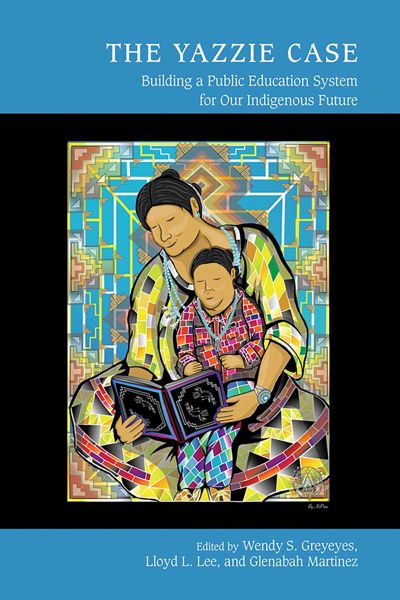
Description

The story of Wilhelmina Yazzie and her son’s effort to seek an adequate education in New Mexico schools revealed an educational system with poor policy implementation, inadequate funding, and piecemeal educational reform. The 2018 decision in the Yazzie/Martinez lawsuit proved what has always been known: the educational needs of Native American students were not being met.

In this superb collection of essays, the contributors cover the background and significance of the lawsuit and its impact on racial and social politics. The Yazzie Case provides essential reading for educators, policy analysts, attorneys, professors, and students to understand the historically entrenched racism and colonial barriers impacting all Native American students in New Mexico’s public schools. It constructs a new vision and calls for transformational change to resolve the systemic challenges plaguing Native American students in New Mexico’s public education system.

Contributors
Georgina Badoni
Cynthia Benally
Rebecca Blum Martínez
Nathaniel Charley
Melvatha R. Chee
Shiv Desai
Donna Deyhle
Terri Flowerday
Wendy S. Greyeyes
Alex Kinsella
Lloyd L. Lee
Tiffany S. Lee
Nancy López
Hondo Louis (photographer)
Glenabah Martinez
Natalie Martinez
Jonathan Nez
Carlotta Penny Bird
Preston Sanchez
Karen C. Sanchez-Griego
Christine Sims
Leola Tsinnajinnie Paquin
Vincent Werito
Wilhelmina Yazzie

About the author(s)

Wendy S. Greyeyes (Diné) is an associate professor of Native American Studies at the University of New Mexico and the chair for the Indian Education Advisory Council for the State of New Mexico.

Lloyd L. Lee (Diné) is a professor of Native American Studies at the University of New Mexico and the director for the Center for Regional Studies.

Glenabah Martinez (Taos/Diné) is an associate professor in the Department of Language, Literacy, and Sociocultural Studies at the University of New Mexico and the director of the Institute for American Indian Education.

Reviews

An unchanged education effectuated by systems and institutions not designed for us will continue to marginalize our Indigenous people and children. The heart of this continuing fight is for justice and equity. It is about the right to exist as we choose. Wilhelmina Yazzie personalizes the heartbreaking story of generations of parents in this struggle. She eloquently speaks of her love of her language and culture and the value of a balanced education, treating both as equally valuable for the health of our children and the future well-being of our people.

The Yazzie Case is an extraordinarily and profoundly compelling call to action. It should be read by policymakers and educators at all levels. The book provides a history that should be required reading for us to realize what we are doing to ourselves in a state where 80 percent of our children come from linguistic and culturally different backgrounds. That is what enriches our diversity. We must act to do the right thing for the right reasons at the right time. This is the time!--Regis Pecos, former governor of Cochiti Pueblo

A superb collection of essays analyzing the issues involved in the Martinez/Yazzie lawsuit and what needs to be done to fully implement the judge's decision supporting the plaintiffs.--Jon Allan Reyhner, coauthor of American Indian Education: A History

A superb collection of essays analyzing the issues involved in the Martinez/Yazzie lawsuit and what needs to be done to fully implement the judge's decision supporting the plaintiffs.--Jon Allan Reyhner, coauthor of American Indian Education: A History

More from series Studies in Indigenous Community Building

More by Wendy S. Greyeyes

More Native American Studies

More American

More Cultural & Ethnic Studies

More Social Science

More All Other Nonfiction

More Child Advocacy

More Educational Policy & Reform

More Education