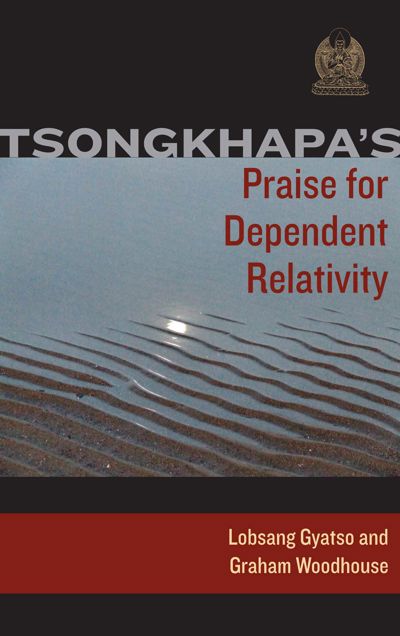
"It is written in exalted reverence and awe for the realization that phenomena come about and cease due to their relationship with other forces, thereby lacking any essence of their own, like flowers in the sky. Though several versions of this praise exist in English translation, this translation by Graham Woodhouse carries the particular terse quality of these Tibetan verse, and with the supplemental commentary by the Geluk lama Losang Gyatso, this makes a valuable text for studying the Prasangika Madhyamaka view."
Description
Tsongkhapa (1357-1419), the author of The Great Treatise on the Stages of the Path to Enlightenment and the teacher of the First Dalai Lama, is renowned as one of the greatest scholar-saints that Tibet has ever produced. He composed his poetic Praise for Dependent Relativity the very morning that he abandoned confusion and attained the final view, the clear realization of emptiness that is the essence of wisdom. English monk Graham Woodhouse, a longtime student of Buddhism, was living near the Dalai Lama's residence in northern India when he translated Tsongkhapa's celebrated text, and he conveys for modern readers the explanation of it he received from his teacher, the late Venerable Lobsang Gyatso.
Reviews
"In this elegant text, the ven Geshe Graham Woodhouse translates Tsongkhapa's jewel-like masterpiece, Praise of Dependent Relativity, a text that draws together metaphysics, ethics and practice with uncommon precision and grace. The radiance of Tsongkhapa's poetry is refracted and enhanced by the brilliant and lucid commentary of the late Gen Losang Gyatso. The translation is direct and elegant. This book will be of enormous value to scholars and practitioners alike."
"This translation gives us access to one of the seminal texts of the Tibetan tradition. It encapsulates the heart of the Tibetan understanding of Buddhist philosophy as understood by Tshongkhapa, one of its most important exponents, and provides an articulation of its most important points, the explanation of how the doctrine of emptiness is compatible with common sense practices. A must read for all those who are interested in this important tradition."
"Tsongkhapa's famous Rten 'brel bstod pa marks Tsongkhapa's awakening. It is a praise of the Buddha as foremost teacher of dependent arising and emptiness, and is accepted by all schools of Tibetan Buddhism as Tsongkhapa's clearest statement of faith. It is a great pleasure to read the precise and flowing translation into English by the Venerable Graham Woodhouse. He has retained the syllabic structure of the Tibetan Buddhist chant, and has interwoven his own profound understanding of the text with an excellent translation of a commentary on it by his teacher, the late Losang Gyatso."