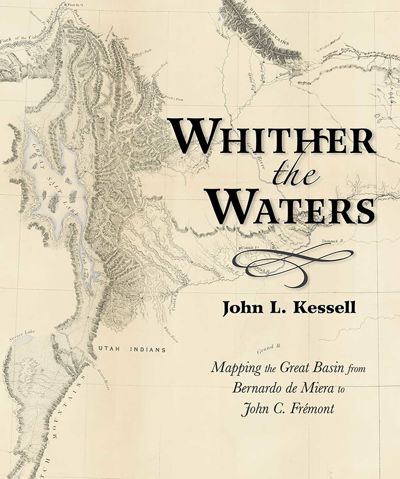
Whither the Waters

Mapping the Great Basin from Bernardo de Miera to John C. Frémont

Description

Bernardo de Miera y Pacheco (1713–1785) is remembered today not only as colonial New Mexico’s preeminent religious artist, but also as the cartographer who drew some of the most important early maps of the American West. His “Plano Geographico” of the Colorado Plateau and Great Basin, revised by his hand in 1778, influenced other mapmakers for almost a century. This book places the man and the map in historical context, reminding readers of the enduring significance of Miera y Pacheco. Later Spanish cartographers, as well as Baron Alexander von Humboldt, Captain Zebulon Montgomery Pike, and Henry Schenck Tanner, projected or expanded upon the Santa Fe cartographer’s imagery. By so doing, they perpetuated Miera y Pacheco’s most notable hydrographic misinterpretations. Not until almost seventy years after Miera did John Charles Frémont take the field and see for himself whither the waters ran and whither they didn’t.
About the author(s)

John L. Kessell, a professor emeritus of history at the University of New Mexico, is the author or editor of many books, including Remote Beyond Compare: Letters of don Diego de Vargas to His Family from New Spain to New Mexico, 1675â€1706 (UNM Press).
Reviews

“Kessell knows Miera so well, and writes so authoritatively, that reading this book is like having him along as a guide on the expedition. . . . Kessell’s book deserves great praise. It represents a superb fusion of image and word, storytelling and analysis, that students of the Southwest will treasure for generations to come.�
â€The Journal of Arizona History

“Kessell’s style is inimitable, and his usage of illustrations and maps masterful.�

“Kessell’s style is inimitable, and his usage of illustrations and maps masterful.�

By means of his detailed yet lively examination of Miera y Pacheco's evolving cartographic images, Kessell offers readers a meticulous case study of cartographic intertextuality and the role of maps in shaping, often powerfully, geographical imaginations and practices.
--Hispanic American Historical Review

More History