Milton Glaser President, Milton Glaser, Inc. It's difficult to imagine a subject more compelling to most human beings than success and failure. Farson and Keyes present a refreshingly original point of view on the subject that illuminates a paradox and challenges our assumptions about how to tell one from the other.
Description
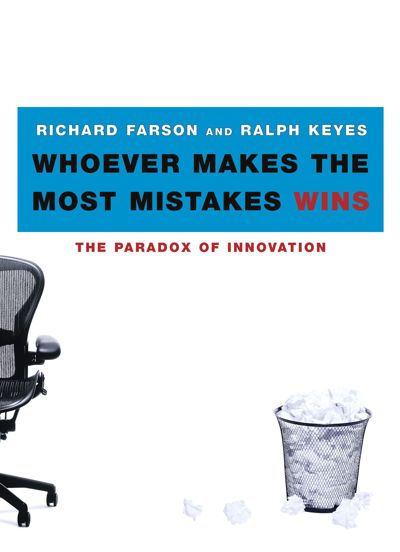
Success in today's business economy demands nonstop innovation. But fancy buzzwords, facile lip service, and simplistic formulas are not the answer. Only an entirely new mindset -- a new attitude toward success and failure -- can transform managers' thinking, according to Richard Farson, author of the bestseller Management of the Absurd, and Ralph Keyes, author of the pathbreaking Chancing It: Why We Take Risks, in this provocative new work.
According to Farson and Keyes, the key to this new attitude lies in taking risks. In a rapidly changing economy, managers will confront at least as much failure as success. Does that mean they'll have failed? Only by their grandfathers' definition of failure. Both success and failure are steps toward achievement, say the authors. After all, Coca-Cola's renaissance grew directly out of its New Coke debacle, and severe financial distress forced IBM to completely reinvent itself.
Wise leaders accept their setbacks as necessary footsteps on the path toward success. They also know that the best way to fall behind in a shifting economy is to rely on what's worked in the past -- as when once-innovative companies like Xerox and Polaroid relied too heavily on formulas that had grown obsolete. By contrast, companies such as GE and 3M have remained vibrant by encouraging innovators, even when they suffered setbacks. In their stunning new book, Farson and Keyes call this enlightened approach "productive mistake-making." Rather than reward success and penalize failure, they propose that managers focus on what can be learned from both. Paradoxically, the authors argue, the less we chase success and flee from failure, the more likely we are to genuinely succeed.
Best of all, they have written a little jewel of a book, packed with fresh insights, blessedly brief, and to the point.
Reviews
Harlan Cleveland President Emeritus, World Academy of Art and Science Truth always seems to come in small paradoxical packages. This delightfully readable package by Farson and Keyes brilliantly fuzzes the frontier between success and failure, and thus reveals the fusion of opposites as the essence of truth.
Michael Murphy Founder, Esalen Institute, and author of Golf in the Kingdom Whoever Makes the Most Mistakes Wins promises to become a classic in the genre of modern wisdom literature that includes Eric Berne's Games People Play and Laurence J. Peter's The Peter Principle. Its unexpected turns, liberating humor, and shrewd observations about social creativity and business innovation have the flavor of Mark Twain mixed with Zen and Taoist ribaldry. This is a wonderful book!
Richard C. Atkinson President, University of California As we move into the twenty-first century, an age of increasingly revolutionary technological advances, the concepts of success and failure must be reinterpreted and transcended if we are to be truly innovative in our ideas and discoveries. Richard Farson and Ralph Keyes provide an insightful and original examination of these concepts and of the critical need to redefine them in the postmodern world.