“The best of Indian, Tibetan, and Western traditions are strung together in this book—a garland of clear jewels that cannot help but reflect the open sky.”
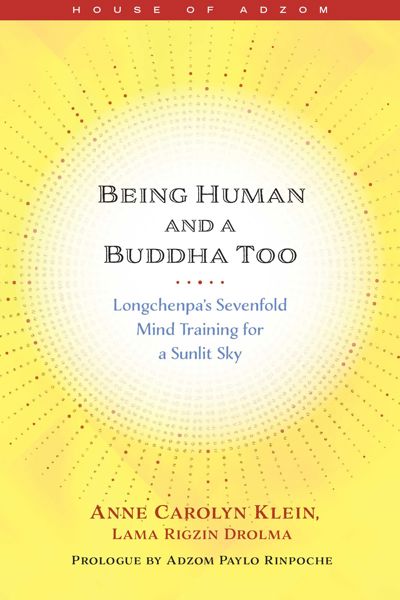
Being Human and a Buddha Too
Longchenpa's Sevenfold Mind Training for a Sunlit Sky
In writing that sparkles and inspires, Anne Klein (Lama Rigzin Drolma) shows us how to liberate our buddha nature to be both human and a buddha too.
This first volume in the House of Adzom series centers on Longchenpa’s seven trainings in bodhicitta, our awakened mind, the ultimate purpose of our practice and training. Anne Klein’s original composition masterfully weaves in Adzom Paylo Rinpoche’s commentary and Jigme Lingpa’s five pith practices and commentary on the trainings, in keeping with Longchenpa’s skillful integration of sutra, tantra, and Dzogchen, to resolve our most challenging questions about what awakening involves and how it relates to the truth of our human situation right now. As foundational teachings for Dzogchen practitioners, the seven trainings are framed as contemplations on impermanence, the adventitiousness of happiness and its short duration, the multiple causes of death, the meaninglessness of our worldly activities, reliance on the Buddha’s good qualities, the teacher’s pith instructions, and, ultimately, nonconceptual meditation on bliss and emptiness, clarity and emptiness, and reality itself.
“The best of Indian, Tibetan, and Western traditions are strung together in this book—a garland of clear jewels that cannot help but reflect the open sky.”
“Being Human and Buddha Too contains a lifetime of meditation on our deeply human capacity for contemplation, reflections on our brokenness and wholeness, and insights into the vastness and intimacy of our lives."
“Thorough, informative, and written like a narrative from a lifelong friend—Klein weaves theory and storytelling together in a graceful and exciting way. A wonderful collection of ancient voices from India to Tibet, gathered here in the pages to further dissipate the devious myth of separateness.”
“Rarely have I seen such a lucid and compelling account of the seeming paradox of being at the same time human, with all its failings, and a buddha, a fully enlightened being. This is a must for anyone who is interested in Tibetan Buddhism, especially in the key insights of Dzogchen teaching.”